# 5. Sustainability - Notable Frameworks
***DESCRIPTION NEEDED HERE***
# 5.1 - What are Notable Frameworks and How Have They Been Applied?
[](https://bookstack.sassafras.dev/uploads/images/gallery/2026-10/sustainability-2.jpg)
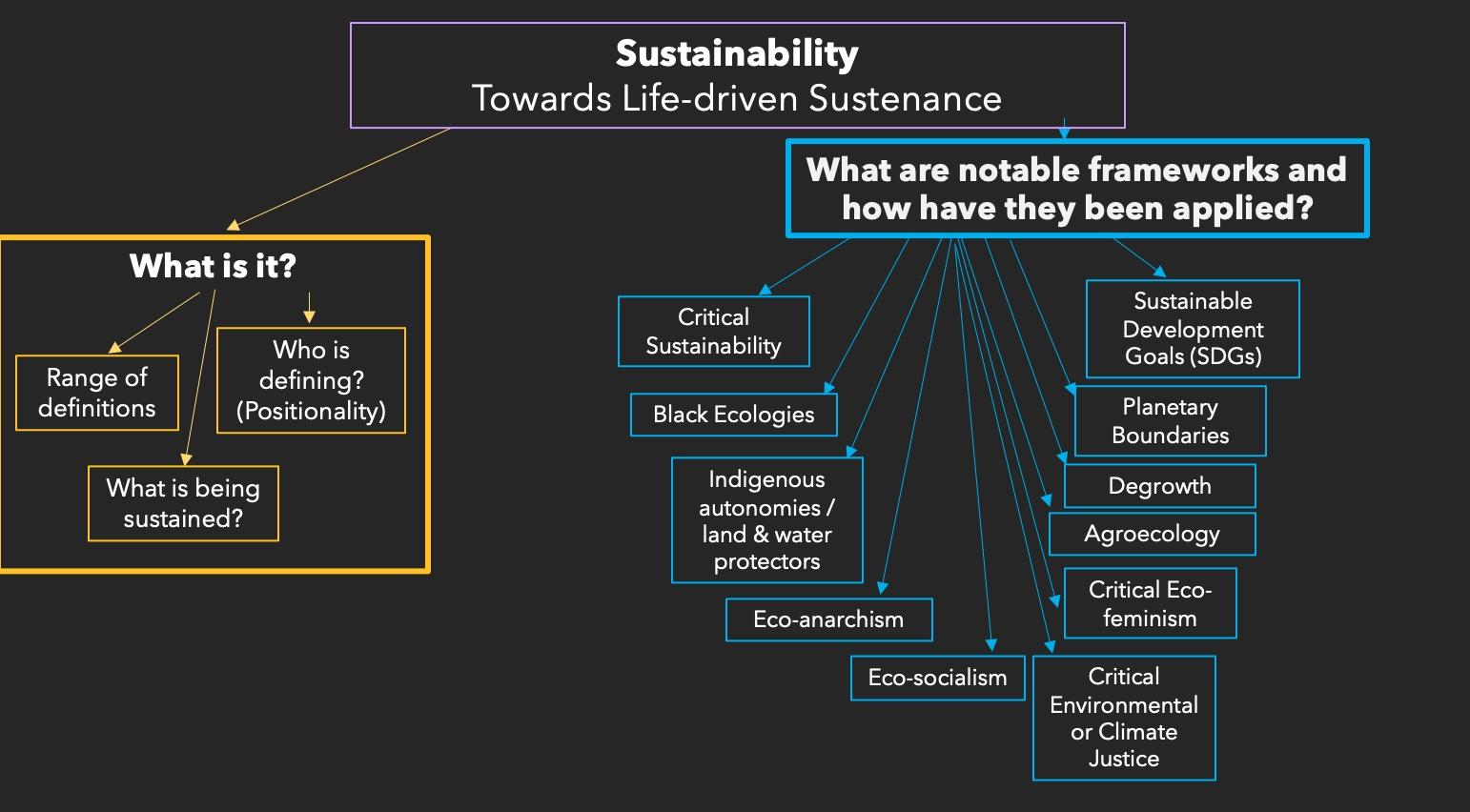
This section attempts to explore and summarize a couple mainstream frameworks to guide an initial introduction to each, but mainly to invite a process of critical analysis and reflexivity. As you delve into each framework and come to explore others, I recommend keeping this expanded version of the key guiding questions in mind:
**Key Guiding Questions (expanded)**
- How does this framework define sustainability?
- What vision is being seeded or sustained? (who benefits and who is harmed by sustaining this vision?)
- Who is defining/driving this vision?
- What are the key approaches/tools used in this sustainability framework?
- What is a representative case study or example of this framework put into practice? If possible, can you surmise how nature/environment are viewed (lifeless?, spiritless?, object, resource, kin, garden, etc.) and what words capture the human-nature relationship in this case study (or in this sustainability framework)?
- What are some of the challenges, critiques or lessons learned with this framework?
- Does this framework bring us closer towards **collective liberation**? How?
# 5.2 - Sustainable Development Goals (SDGs) & Planetary Boundaries
[](https://bookstack.sassafras.dev/uploads/images/gallery/2026-10/sustainability-1.jpg)
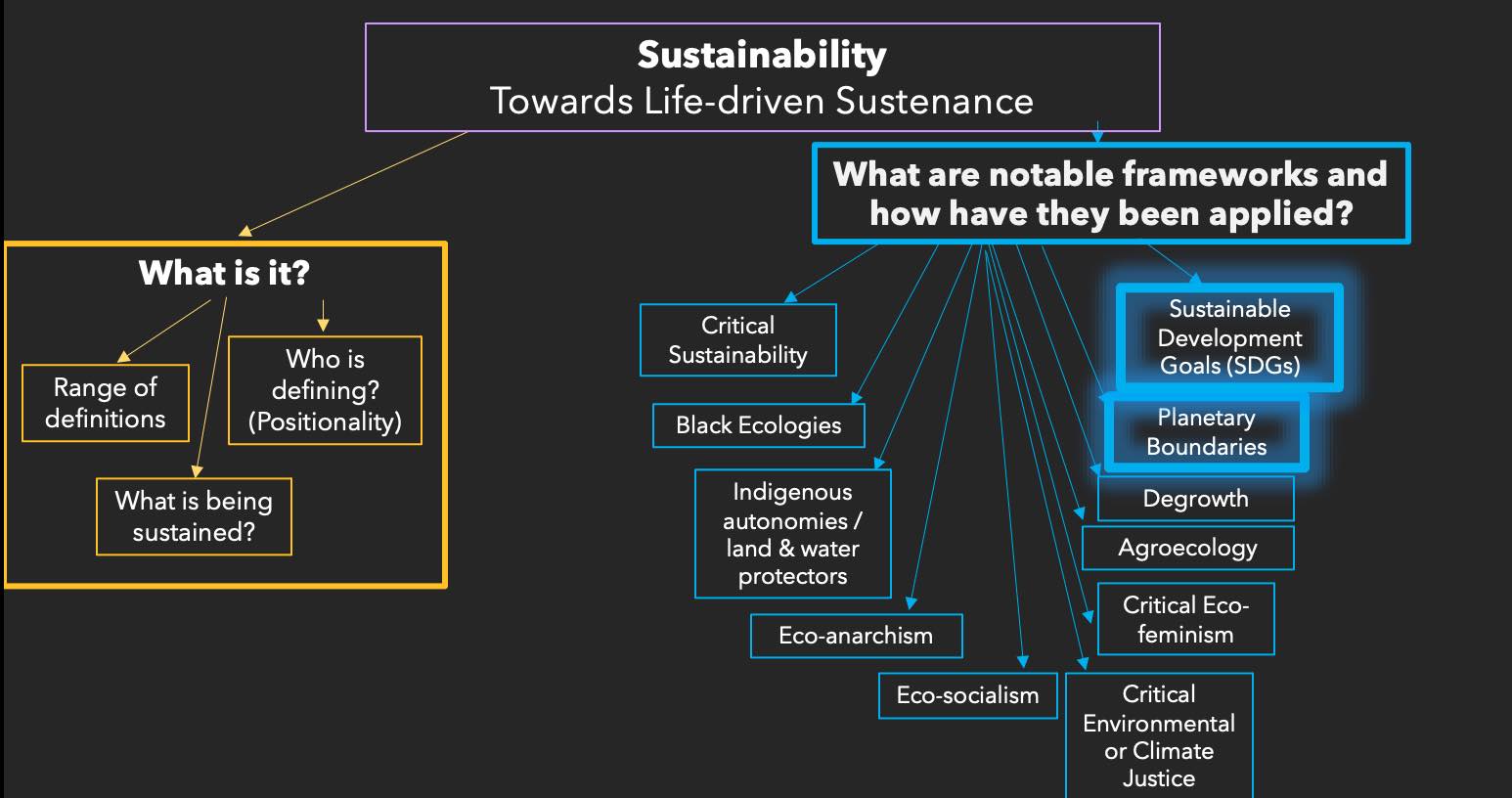
Two of the most prominent mainstream sustainability frameworks include the United Nations **anthropocentric** focused sustainable development goals (SDGs) and the techno-scientific, **ecocentric** planetary boundaries. Interestingly, these reflect a long-standing cartesian dualism between anthropocentric and ecocentric approaches to sustainability.
The sustainable development goals (SDGs) are the most recent multilateral set of global goals (its predecessor being the Millenium Development Goals) that include a total of 17 goals and 169 targets created by the United Nations that define the guidelines for policies on sustainable development from 2015 to 2030 (Kothari et al 2019). In their book ‘Pluriverse: a post-development dictionary’, Kothari et. al. (2019) summarize the key critiques of sustainable development highlighting the structural imposition of a **neoliberal globalization** agenda that makes **‘economic growth’** a necessary step in sustainable development by arguing that “a high standard of living is necessary before using resources to protect the environment”. A high standard of living as defined by the neoliberal and neoimperialist agendas of the **Global North** refers to a homogenizing model of modernity where individuals have ‘jobs’, access to healthcare, schooling, the right to ‘vote’ for political parties, and the ability to be consumers plugged into a global market.
The framework of planetary boundaries refers to specific thresholds for 9 key earth system processes, or planetary boundaries, within which humanity can continue to survive, develop and thrive by maintaining the current Holocene epoch-like planetary conditions (‘safe operating space’) for generations to come as identified by a group of earth system scientists. These include climate change, biosphere integrity, biogeochemical flows, land system change, freshwater change, ocean acidification, chemical pollution and novel entities (plastics), stratospheric ozone depletion, and atmospheric aerosol loading (Rockstrom, 2009; [van Vuuren etal 2025](https://www.nature.com/articles/s41586-025-08928-w)). This framework has been highly influential in igniting environmental academic debate and in shaping research programs and environmental policy at national and international scales.
To really dive into the planetary boundaries sutainability framework watch the Netflix documentary – Breaking Boundaries: the science of our planet (73 mins). Remember to use our key guiding questions to interrogate.
Without a doubt, there are parallel dialogues and liberatory movements for a more dignified and sustainable existence on Earth that emanate from traditions of resistance, Marxism, anarchism and land and water protectors that includes Black ecologies, Indigenous ecologies, degrowth, ecofeminism, ecoanarchism, agroecology, ecosocialism, climate justice and critical sustainabilities (to name a few). It is these frameworks that I invite you to delve into as we think about a more just, liberatory, and dignified sustainability.
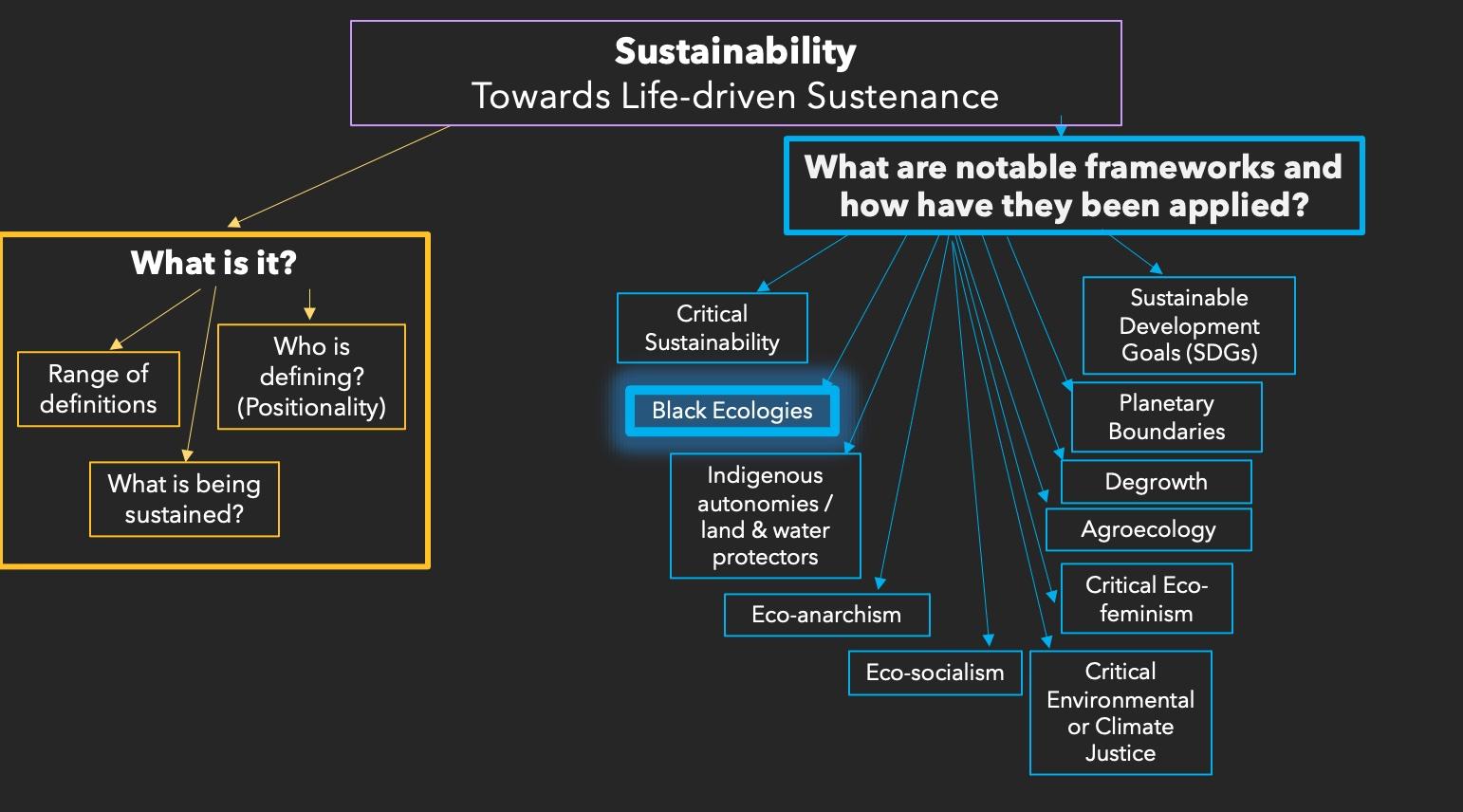
For the remainder of this module, I will introduce ‘Black ecologies’ as a sustainability framework to exemplify how the ‘key guiding questions’ can be used on our learning journey.
**anthropocentric** = an ideology or approach to sustainability that prioritizes human socioeconomic development (in line with capitalist modernity) including ending world hunger, the eradication of poverty, the reduction of inequality, economic growth, and decent jobs (Biermann and Kim 2020).
**ecocentric** = an ideology or approach to sustainability that prioritizes the protection of nature and the environment over socioeconomic development.
neoliberal globalization
economic growth
Global North =
# 5.3 - Voices of Black Ecologies
[](https://bookstack.sassafras.dev/uploads/images/gallery/2026-10/sustainability-3.jpg)
I draw on the scholarship and shared accounts of Teona Williams, Cherie Rivers Ndaliko, Ron Finley, Katherine Benjamin Golden, JT Roane, Justin Hosbey, and Delali Kumavie to address the key guiding questions.
I fully acknowledge that I do this positioned as a Mexican American of campesina roots who has sought to center Black ecologies and **futurities** for my students of color. I do not seek to speak for these brilliant scholars and practitioners who deeply embody Black ecologies, but instead want to create the space for us to be in conversation about their inspirational work, ideas and liberatory initiatives.
[](https://bookstack.sassafras.dev/uploads/images/gallery/2026-10/YVMimage.png)
**Teona Williams**
ASSISTANT PROFESSOR, Geography & Environment, Rutgers-New Brunswick
Research Interests: Black geographies, Black feminism, African American and environmental history, Black Ecologies, critical food studies, critical disaster studies, the Black South(s), and rural geographies
• Award for [“Build A Wall Around Hyde Park”: Race, Space and Policing on the Southside of Chicago 1950-2010](https://antipodeonline.org/2021/04/08/race-policing-and-land-grabbing/)
[](https://bookstack.sassafras.dev/uploads/images/gallery/2026-10/EEGimage.png)
**Chérie Rivers Ndaliko**
ASSOCIATE PROFESSOR, Geography, University of North Carolina – Chapel Hill
• Writer, teacher, mother, and radical Black ecologist—is rooted in her commitment to interrupting modern colonialism with the transformative power of imagination.
• Her courses focus on taking the ideas that are put forward by radical Black thinkers and artists and to reimagine ways to organize ourselves culturally, economically and politically.
[](https://bookstack.sassafras.dev/uploads/images/gallery/2026-10/ckJimage.png)
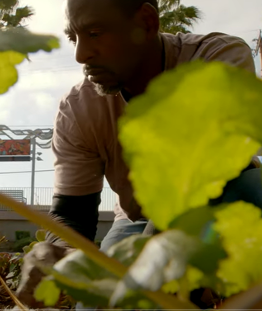
**Ron Finley**
Community Leader, Father,
• gangster gardner who demanded space to do urban gardening in LA
[](https://bookstack.sassafras.dev/uploads/images/gallery/2026-10/DTJimage.png)
**Kathryn Benjamin-Golden**, Assistant Professor of Africana Studies at University of Delaware. Historian focused on insurgent ecologies
[](https://bookstack.sassafras.dev/uploads/images/gallery/2026-10/rjKimage.png)
**JT Roane**, Assistant Professor of Africana Studies and Geography at Rutgers University. His work focuses on black geographies, black ecologies, and Black spatial insurgency
[](https://bookstack.sassafras.dev/uploads/images/gallery/2026-10/myTimage.png)
**Justin Hosbey**, Professor at UC - Berkeley. Black Studies, Black Ecologies and humanistic social science research
[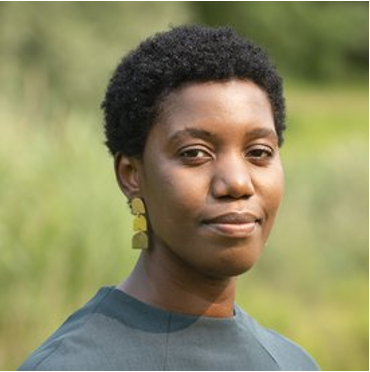](https://bookstack.sassafras.dev/uploads/images/gallery/2026-10/T4Eimage.png)
**Delali Kumavie**
ASSISTANT PROFESSOR, English and Women & Gender Studies, Syracruse University
• teaching and research interests are situated at the intersection of Global Black Literature, Studies in Science and Technology, Global Migration, and Black Ecologies
futurities: the act of living out the futures we wish and the creation of the conditions for these futures (Harjo 2019)
Williams, T. 2023. Keyword on Black Ecologies. The International Encyclopedia of Geography: People, the Earth, Environment and Technology
https://muse.jhu.edu/article/860483 Of Clay and Wonder