Sustainability
Towards Life-Driven Sustenance
Module Developed by Marlene Brito-Millán
- 1. Sustainability - About
- 2. Perspective & Positionality
- 3. Sustainability - What Is It?
- 4. Sustainability - What Is Being Sustained?
- 5. Sustainability - Notable Frameworks
- 5.1 - What are Notable Frameworks and How Have They Been Applied?
- 5.2 - Sustainable Development Goals (SDGs) & Planetary Boundaries
- 5.3 - Voices of Black Ecologies
- 6. Black Ecologies
- 6.1 - How Does This Framework Define Sustainability?
- 6. 2 - What are the Key Approaches/Tools Used in this Sustainability Framework?
- 6.3 - NEED A TITLE FOR THIS PAGE - Cancer Alley, Maybe?
- 6.4 - NEED A TITLE FOR THIS PAGE
- 6.5 - NEED A TITLE FOR THIS PAGE
- 6.6 - NEED A TITLE FOR THIS PAGE - Lessons Learned with this Framework? (Maybe)
- 6.7 - NEEDS A TITLE FOR THIS PAGE - Towards Collective Liberation? (Maybe)
- 7 - CONCLUSION TITLE NEEDED HERE
1. Sustainability - About
What is this about?
This module aims to complicate the logics underlying mainstream sustainability by interrogating the premises/assumptions of dominant frameworks and centering lifeways and practices of people who are protecting or re-materializing possibilities for a dignified, life-cultivating, localized and pluriversal existence on our planet.
Why does this module matter?
At the core, this module amplifies liberatory approaches and futurities rooted in Indigenous, Black, and localized ecological relations of responsibility, respect, and interdependence. This is important because mainstream discouse is focused mainly on Eurocentric technocratic solutions that do not disrupt systems of oppression nor the disproportionate impact of greenwashed “solutions” on minoritized groups and the environment, while actively shutting out the myriad insurgent and life-focused ways of relating to the planet.
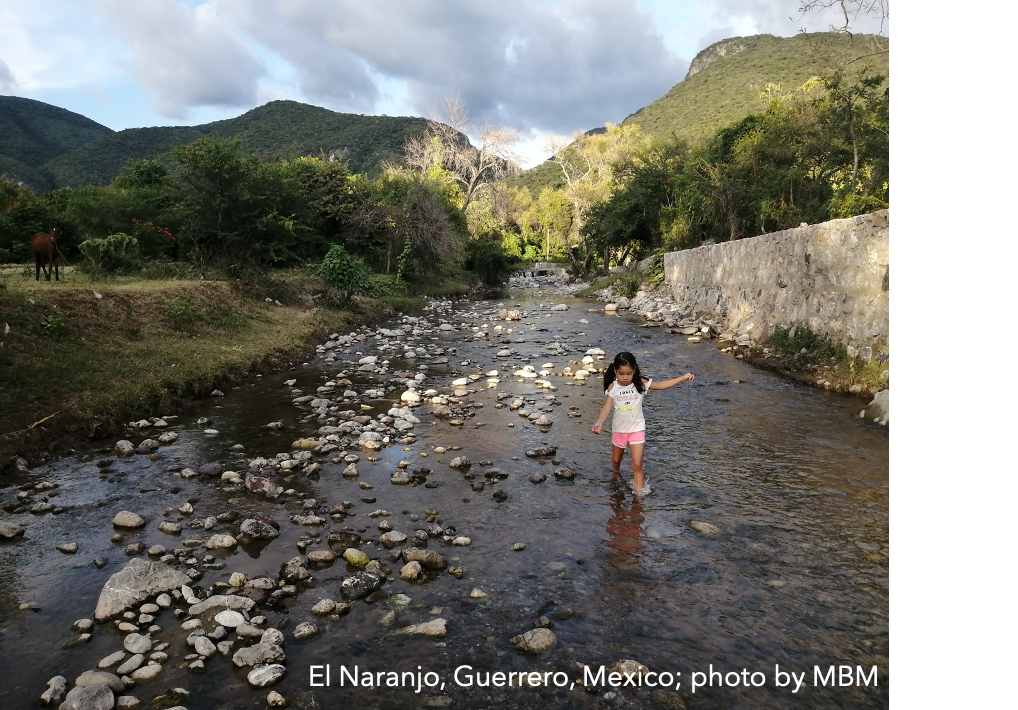
pluriversal = referring to an alternative vision of the world as an entangled, yet coexisting, multiplicity of ways of knowing, valuing, relating and being that disrupt the dominant and homogenizing processes of modernity, globalization, extractivism, neo-colonialism, racial capitalism, state domination, and heteropatriarchy. further reading: https://medium.com/age-of-emergence/demystifying-the-pluriverse-as-the-hegemony-unravels-f85b93dd605e ; https://radicalecologicaldemocracy.org/wp-content/uploads/2020/09/Pluriverse-full-printable-version-July-2019.pdf
2. Perspective & Positionality
What perspective/positionality is this module created from?
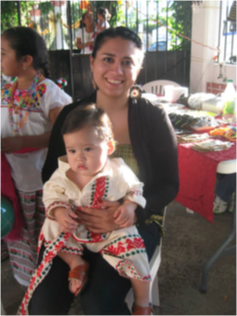
I, Marlene Brito-Millán am a Mexican American women of campesin@ roots, a mother, an ecologist, founder of the 'Indigenous Ecologies Collaboratory', co-organizer at the-ciej.org - a collective of scientists, artivists, mothers, and academics aligned with Indigenous resistance, resurgence, and ongoing autonomies for land, water, and life through the practice of decolonial feminist science and solidarity science. I am also an Assistant Professor at the School for Environmental Sustainability at Loyola University Chicago.
What does this module comprise?
A concept map that guides through key sustainability frameworks with the aim of centering multiple ways of knowing. I introduce a set of key guiding questions to critically interrogate sustainability frameworks and highlight the centrality of caretakers, protectors, and people mobilizing around the globe away from extractivist, imperial, racial capitalist, and heteropatriarchal modes towards life-driven, adaptable, convivial, collectivist, hyper-localized ways of existence. I use the key guiding questions to introduce Black Ecologies as a powerful form of sustenance and leave readers with a set of links and resources for a continued exploration of the various manifestations of sustainability and sustenance.
decolonial feminist science = a scientific method that centers long-term, care-oriented, horizontal relations with people, places and liberatory movements, practices reflexivity in researcher’s positionality, and is in service of Indigenous communities agency and autonomy through aligning resources, laboratories and goals; http://www.the-ciej.org/
solidarity science = a way of practicing science that aims to be in solidarity with, not undermine, Indigenous epistemological practices and forms of knowledge production https://magazine.scienceforthepeople.org/vol22-1/agua-es-vida-solidarity-science-against-false-climate-change-solutions/
extractivism = “extracting is stealing...it is taking without consent, without thought, care or even knowledge of the impacts on living things in an environment” often for the purpose of wealth accumulation or knowledge production; https://www.yesmagazine.org/social-justice/2013/03/06/dancing-the-world-into-being-a-conversation-with-idle-no-more-leanne-simpson
racial capitalism = the concept that racial hierarchies and capitalist economic systems are not separate but mutually reinforcing and interconnected, in other words, capitalism relies on and perpetuates racial hierarchies to accumulate wealth and power; Robinson 1983 – Black Marxism: the making of the Black Radical Tradition; https://www.bostonreview.net/articles/robin-d-g-kelley-introduction-race-capitalism-justice/ Fraser, Nancy. “How Capitalism Worms Its Way Into Every Aspect of Our Lives”. Jacobin. 12.08.2022. https://jacobin.com/2022/12/dig-nancy-fraser-capitalism-social-reproduction-race-gender
convivial = in reference to the “concept of Tools for Conviviality, where technology is limited to that which supports an enriching balance of individual autonomy and social connection between people as well as a harmonious relationship with the environment” Ivan Illich, Tools for Conviviality (London: Marion Boyers, 2001)
hyper-localized = a way of living that cultivates interdependent and sustainable relations with the local environment and people to break the cyle of globalized extraction-based consumerism so that we can sustain ourselves through local work that meets needs while sustaining our communities. http://www.the-ciej.org/local-interdependence.html
3. Sustainability - What Is It?
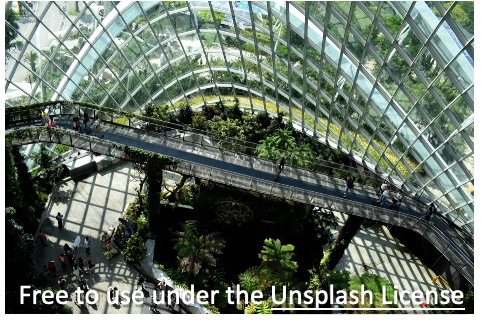
Sustainability often brings to mind thoughts about recycling, green infrastructure, electric vehicles, renewable energy, circular economies and high-tech green futures. Moreover, the definition of sustainability can be variable depending on who is defining it and it can be conflated with concepts like sustainable development (which is related but different). For example, read the selection of definitions below and reflect on the key questions that follow:
- “sustainabile development is meeting the needs of the present without compromising the ability of future generations to meet their own needs” - United Nations World Commission on Environment and Development (Brundtland Commission 1987)
- sustainability is staying within the ‘safe operating space’ of the 9 planetary boundaries within which humanity can survive, develop and thrive for generations to come. These include climate change, biosphere integrity, biogeochemical flows, land system change, freshwater change, ocean acidification, chemical pollution and novel entities (plastics), stratospheric ozone depletion, and atmospheric aerosol loading (Rockstrom, 2009; van Vuuren etal 2025)
- “transformative sustainability ignites a deep sense of interpersonal connection with place, fostering an engagement, both affective and cognitive, with the material and cultural contexts and realities as well as the communities, constituting the place they are situated in” (Maison 2022)
- “critical sustainability recognizes the material and ecological necessities that sustain all life on the planet, while also acknowledging and seeking out sociopolitical orientations that support dignity, equity, respect, and rights for all parties.” (Rose and Cachelin 2018)
To compare these definitions, try to answer the following key guiding questions and discuss with others joining you in this module:
Key Guiding Questions (condensed)
- What are the differences and similarities across these definitions?
- How are ‘needs’ or ‘necessities’ conceived across definitions?
- Reflect on who is defining each (what is their positionality) and why does that matter?
- What vision of the world is being sustained?
- Do any of these bring us closer towards collective liberation and how?
Mainstream sustainability is broadly conceived as the practice of living on planet earth in a way that minimizes depletion of ‘natural’ resources and minimizes pollution so that future generations are not compromised. This conception of sustainability tends to center the environmental dimension, which has led to provocative critical analyses from Indigenous studies (McGregor etal 2020), political ecology (Brito-Millan et al 2023), environmental humanities (Blanco et al 2024), economics (Biermann and Rakhyun 2010), and science and technology studies (Turnhout 2022) fields (amongst others).
Even though, sustainability is a recent term that became popularized in the last half century, ‘sustainable’ human practices and lifeways have existed throughout history across cultures around the world. There are a myriad of flavors of sustainability (even though, they are not called sustainability – a good question is why?) where people have cultivated strong interdependent, responsible relations with their surroundings and with more-than-human kin to embody a profound model of sustainability. A few examples include stewardship (Kyle Whyte), kinship (Kyle Whyte), caretaking (Tallbear), buen vivir (Kawsak Sacha), ecological swaraj, ubuntu, and architects of abundance (Lyla June).
circular economy = an economic model that seeks to make consumption sustainable by emphasizing reuse, recycle, repair, sharing, leasing and minimizing disposability to shift production and consumption into a circular cycle (rather than a linear process that ends in waste and pollution). https://en.wikipedia.org/wiki/Circular_economy
renewable energy = energy derived from ‘natural sources’ that do not run out, such as solar, wind, tides, geothermal heat; however, the technology needed to harness these are often built from finite sources (including fossil fuels) (Hoodwinked in the Hothouse zine https://climatefalsesolutions.org/welcome/)
positionality = the social, political and cultural context that shapes a persons identity and perspective, influencing how they engage with and interpret the world around them (including research); “Positionality is about our relationships between each other, the origins and formations of our ideas and knowledge, and the actions we credit to ourselves and others. ” https://library.fiveable.me/key-terms/introduction-cultural-anthropology/positionality https://www.commonground.org.au/article/what-is-positionality also see section on positionality in next section.
Caretaking relations, not American dreaming
K TallBear - Kalfou, 2019 - search.proquest.com
Indigenous environmental justice: Anti-colonial action through kinship
K Whyte - Environmental justice, 2020 - taylorfrancis.com
more-than-human = sentience, agency, purpose, emotion, intelligence and spirituality that includes and goes beyond co-dwelling of multiples species on our planet https://www.ecologicalcitizen.net/what-is.php?t=more-than-human-world-definition
4. Sustainability - What Is Being Sustained?
What does living a ‘good life’ mean to you?
- where greenwashed renewable energy technologies continue to depend on extraction, hegemony, dispossession, ecofascism, genocide; a reality masked under the label of ‘sustainability’ produced to quell moral predicaments of consumers
- divided by highly militarized and lethal borders (under the hegemonic pretext of securing ‘national’ interests) that have severe impacts on land, water, people and migratory fauna
- where living and ‘nonliving’ beings are sacrificed and reduced to‘resources’ for extraction (stolen) and transported globally to further ‘development and urbanization’ dressed as green technological modernity
- with a widening wealth gap that concentrates power, materials and money for the few while a growing impoverished class struggles to cover basic necessities
- where the expansion of entitled tourism that ‘touts access to any place in the world’ has become an environmentally and culturally destructive force that gentrifies and homogenizes diverse lifeways and at its worst drives trafficking of people, exotics, and drugs
- the exponentially growing time spent on screens steals more and more attention from our families and communities while resulting in debilitating social isolation and consumption of tremendous amounts of energy, water, and land
- that clings to the illusion of “consumer choice” in a cycle of mass production, hyperconsumption, disposability, perpetual waste steams and toxic pollution
- where the continued promotion and expansion of modern high-tech lifestyles extracts labor from women, people of color, immigrants, and those “othered” as well as land from Original Peoples – many of these folx continue to resist indoctrination into monetized existences for which appetites are stoked in factory models of schooling that produces workers.
Who is defining/driving this hegemonic vision of sustainability?
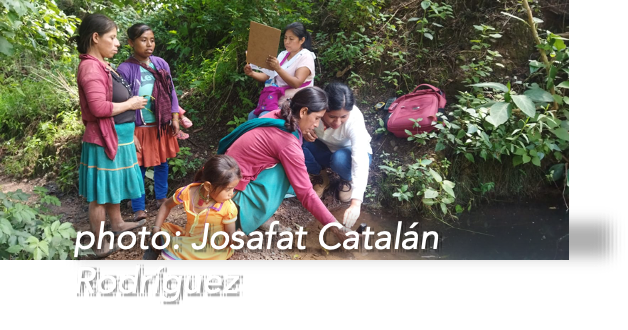
Can you think of (or find) any land-, water-, air-, or life-centered actions, programs, circles, collectives, organizations in your area that integrate an analysis of power, from say a decolonial, feminist, antipatriarchical lens (within a 15 mile radius)? If not, try doing an internet search to see what comes up.
Considering Positionality
Camaroon, https://youtu.be/EgrFvayJhE0?si=nGHH_LJ1sqKzTRV3&t=412
Nina Gualinga, Sarayaku https://www.youtube.com/watch?v=XOPZ7nU8I3s&t=409s
Nina Gualinga, Sarayaku – Mujeres Guardianas de la Selva (watch with English autotranslation)
local autonomous governance = the act of regulating local community life in line with a peoples own definition of a ‘good life’ based on their own culture and sociopolitical structures; “its other name is dignity” (Esteva, 2003 A flower in the hands of the people)
5. Sustainability - Notable Frameworks
DESCRIPTION NEEDED HERE
5.1 - What are Notable Frameworks and How Have They Been Applied?
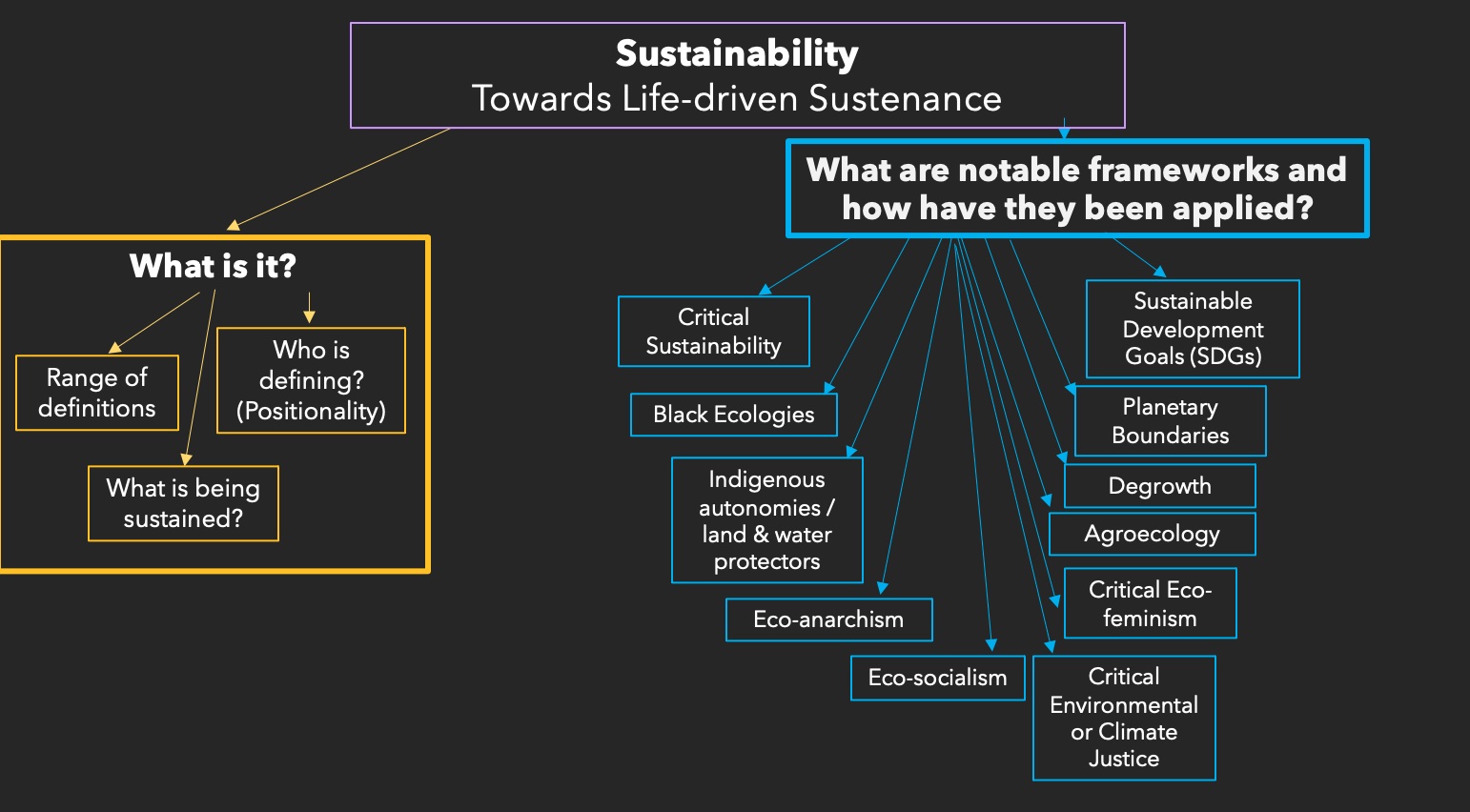
This section attempts to explore and summarize a couple mainstream frameworks to guide an initial introduction to each, but mainly to invite a process of critical analysis and reflexivity. As you delve into each framework and come to explore others, I recommend keeping this expanded version of the key guiding questions in mind:
Key Guiding Questions (expanded)
- How does this framework define sustainability?
- What vision is being seeded or sustained? (who benefits and who is harmed by sustaining this vision?)
- Who is defining/driving this vision?
- What are the key approaches/tools used in this sustainability framework?
- What is a representative case study or example of this framework put into practice? If possible, can you surmise how nature/environment are viewed (lifeless?, spiritless?, object, resource, kin, garden, etc.) and what words capture the human-nature relationship in this case study (or in this sustainability framework)?
- What are some of the challenges, critiques or lessons learned with this framework?
- Does this framework bring us closer towards collective liberation? How?
5.2 - Sustainable Development Goals (SDGs) & Planetary Boundaries
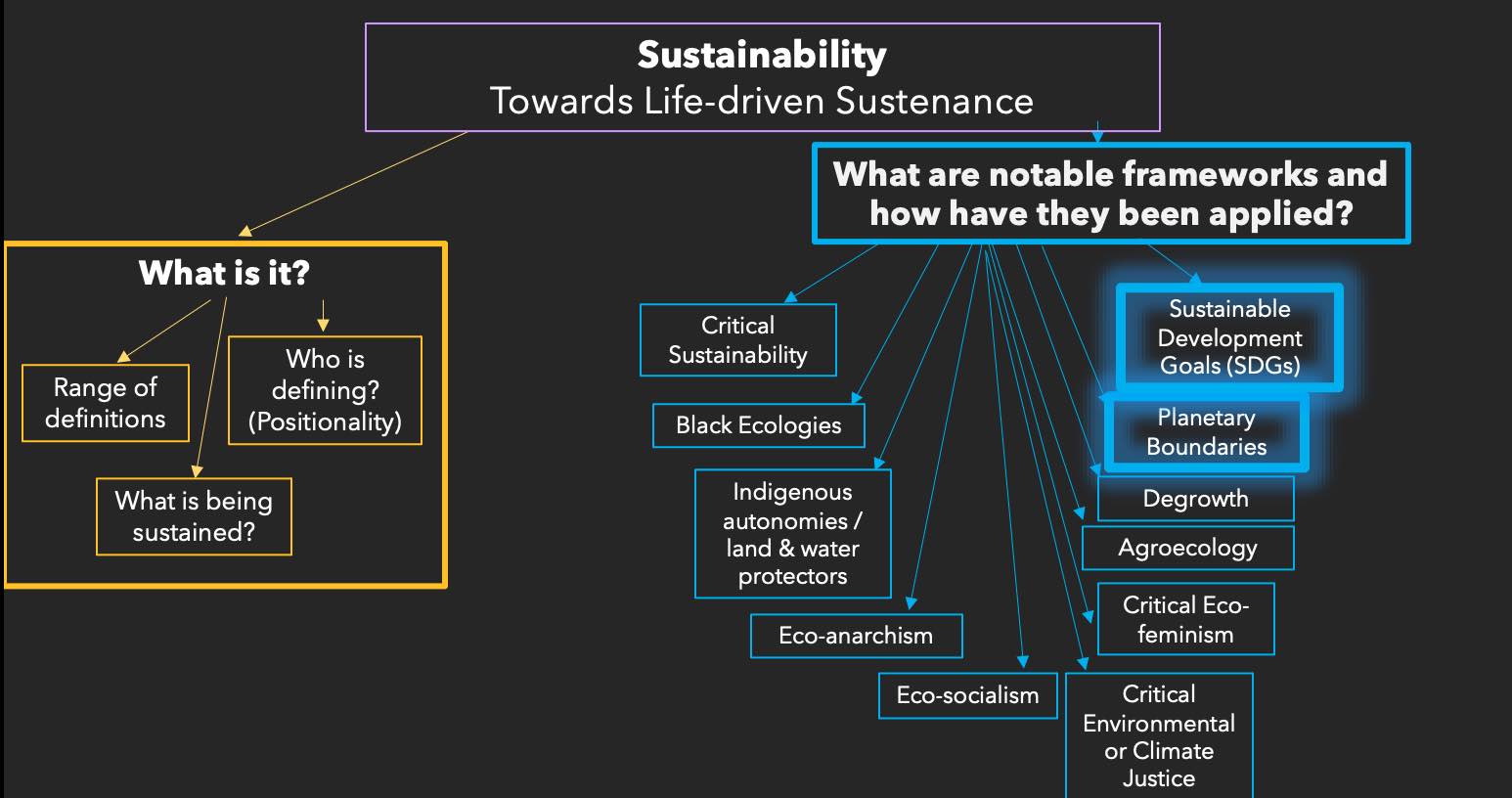
Two of the most prominent mainstream sustainability frameworks include the United Nations anthropocentric focused sustainable development goals (SDGs) and the techno-scientific, ecocentric planetary boundaries. Interestingly, these reflect a long-standing cartesian dualism between anthropocentric and ecocentric approaches to sustainability.
The sustainable development goals (SDGs) are the most recent multilateral set of global goals (its predecessor being the Millenium Development Goals) that include a total of 17 goals and 169 targets created by the United Nations that define the guidelines for policies on sustainable development from 2015 to 2030 (Kothari et al 2019). In their book ‘Pluriverse: a post-development dictionary’, Kothari et. al. (2019) summarize the key critiques of sustainable development highlighting the structural imposition of a neoliberal globalization agenda that makes ‘economic growth’ a necessary step in sustainable development by arguing that “a high standard of living is necessary before using resources to protect the environment”. A high standard of living as defined by the neoliberal and neoimperialist agendas of the Global North refers to a homogenizing model of modernity where individuals have ‘jobs’, access to healthcare, schooling, the right to ‘vote’ for political parties, and the ability to be consumers plugged into a global market.
The framework of planetary boundaries refers to specific thresholds for 9 key earth system processes, or planetary boundaries, within which humanity can continue to survive, develop and thrive by maintaining the current Holocene epoch-like planetary conditions (‘safe operating space’) for generations to come as identified by a group of earth system scientists. These include climate change, biosphere integrity, biogeochemical flows, land system change, freshwater change, ocean acidification, chemical pollution and novel entities (plastics), stratospheric ozone depletion, and atmospheric aerosol loading (Rockstrom, 2009; van Vuuren etal 2025). This framework has been highly influential in igniting environmental academic debate and in shaping research programs and environmental policy at national and international scales.
To really dive into the planetary boundaries sutainability framework watch the Netflix documentary – Breaking Boundaries: the science of our planet (73 mins). Remember to use our key guiding questions to interrogate.
Without a doubt, there are parallel dialogues and liberatory movements for a more dignified and sustainable existence on Earth that emanate from traditions of resistance, Marxism, anarchism and land and water protectors that includes Black ecologies, Indigenous ecologies, degrowth, ecofeminism, ecoanarchism, agroecology, ecosocialism, climate justice and critical sustainabilities (to name a few). It is these frameworks that I invite you to delve into as we think about a more just, liberatory, and dignified sustainability.
For the remainder of this module, I will introduce ‘Black ecologies’ as a sustainability framework to exemplify how the ‘key guiding questions’ can be used on our learning journey.
anthropocentric = an ideology or approach to sustainability that prioritizes human socioeconomic development (in line with capitalist modernity) including ending world hunger, the eradication of poverty, the reduction of inequality, economic growth, and decent jobs (Biermann and Kim 2020).
ecocentric = an ideology or approach to sustainability that prioritizes the protection of nature and the environment over socioeconomic development.
neoliberal globalization
economic growth
Global North =
5.3 - Voices of Black Ecologies
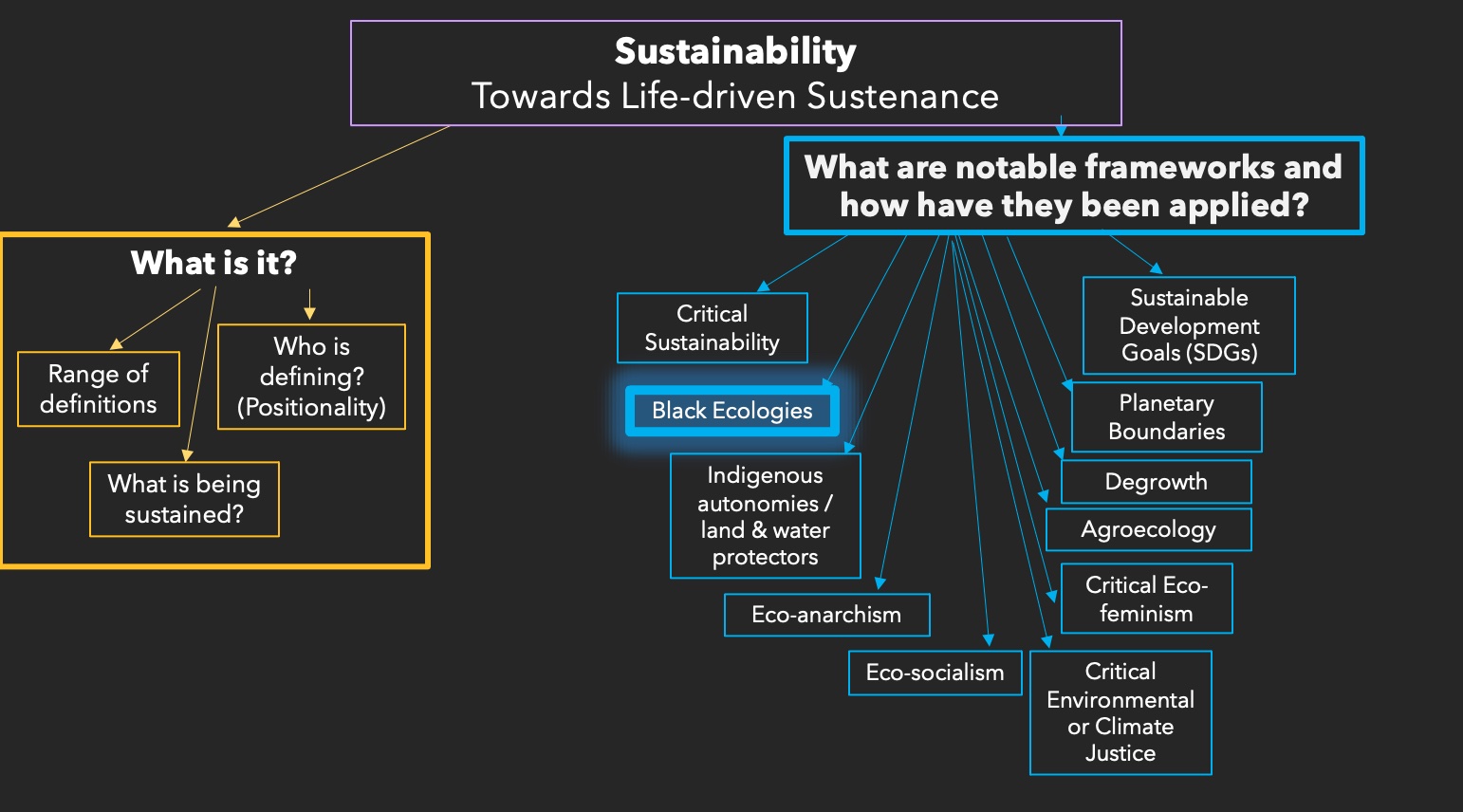
I draw on the scholarship and shared accounts of Teona Williams, Cherie Rivers Ndaliko, Ron Finley, Katherine Benjamin Golden, JT Roane, Justin Hosbey, and Delali Kumavie to address the key guiding questions.
I fully acknowledge that I do this positioned as a Mexican American of campesina roots who has sought to center Black ecologies and futurities for my students of color. I do not seek to speak for these brilliant scholars and practitioners who deeply embody Black ecologies, but instead want to create the space for us to be in conversation about their inspirational work, ideas and liberatory initiatives.

Teona Williams
ASSISTANT PROFESSOR, Geography & Environment, Rutgers-New Brunswick
Research Interests: Black geographies, Black feminism, African American and environmental history, Black Ecologies, critical food studies, critical disaster studies, the Black South(s), and rural geographies
• Award for “Build A Wall Around Hyde Park”: Race, Space and Policing on the Southside of Chicago 1950-2010

Chérie Rivers Ndaliko
ASSOCIATE PROFESSOR, Geography, University of North Carolina – Chapel Hill
• Writer, teacher, mother, and radical Black ecologist—is rooted in her commitment to interrupting modern colonialism with the transformative power of imagination.
• Her courses focus on taking the ideas that are put forward by radical Black thinkers and artists and to reimagine ways to organize ourselves culturally, economically and politically.
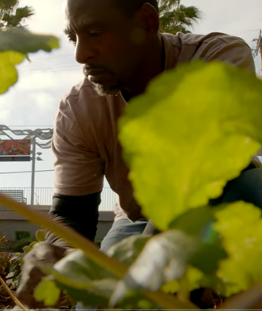
Ron Finley
Community Leader, Father,
• gangster gardner who demanded space to do urban gardening in LA

Kathryn Benjamin-Golden, Assistant Professor of Africana Studies at University of Delaware. Historian focused on insurgent ecologies

JT Roane, Assistant Professor of Africana Studies and Geography at Rutgers University. His work focuses on black geographies, black ecologies, and Black spatial insurgency

Justin Hosbey, Professor at UC - Berkeley. Black Studies, Black Ecologies and humanistic social science research
Delali Kumavie
ASSISTANT PROFESSOR, English and Women & Gender Studies, Syracruse University
• teaching and research interests are situated at the intersection of Global Black Literature, Studies in Science and Technology, Global Migration, and Black Ecologies
futurities: the act of living out the futures we wish and the creation of the conditions for these futures (Harjo 2019)
Williams, T. 2023. Keyword on Black Ecologies. The International Encyclopedia of Geography: People, the Earth, Environment and Technology
https://muse.jhu.edu/article/860483 Of Clay and Wonder
6. Black Ecologies
DESCRIPTION NEEDED HERE
6.1 - How Does This Framework Define Sustainability?
Key Guiding Questions (expanded)
How does this framework define sustainability?
Black ecologies views sustainability not just as ecological stability, but as an antiracist, abolitionist, and autonomous reality where Black life and communities can flourish with political and economic agency, respectful, reciprocal, and generative ecological relationships, reconnecting with land, and building collective wellness rooted in a vibrant tradition of mutual aid and insurgent knowledge.
What vision is being seeded or sustained? (who benefits and who is harmed by sustaining this vision?)
It envisions an end to antiblackness, environmental racism, and ecocidal capitalism, “while passing on cultural traditions, ecological and world-sustaining knowledge, and zones of refuge that allow us to imagine and produce beauty and joy in our environments.” – Hosbey et al 2022
“Black ecologies are an abolitionist vision of futures rooted in multispecies kinship, freedom, ecological stewardship, racial justice, Black repair, and social equity” – Moulton and Salo 2022
In Black ecologies there is an explicit liberatory vision for racialized communities of color, particularly Black communities, and the places they draw sustenance from, both of which have been historically and systemically subjugated by white supremacy, colonialism and racial capitalist power structures. In terms of costs (contamination and environmental destruction), this framework dissipates costs by calling for the dismantling of dominant power structures that perpetuate environmental and social injustices upon poor, working class, and communities of color as well as interrupting the processes that end in wastelanding, pollution, and extirpation of large tracts of ecosystems.
Who is defining/driving this vision?
There has been a long tradition of Black ecologies (despite the recently coined term) and Black geographies for centuries, but more recently, Black ecologies is a framework carried forth by Black scholars, community organizers and leaders, as well as practitioners, and other allies / accomplices. Refer to the ‘Voices of Black Ecologies’ section.
abolitionist : Ruth Wilson Gilmore states that “abolition is a constant becoming” that “interrupts harm perpetuated by policing, incarceration, and detention of racialized, ciminalized and undocumented communities to build infrastructures that reduce harm without relying on oppression and violence” (Snider 2022, Simpson center). In addition to Wilson Gilmore, prominent writings include works by Mariame Kaba and Angela Davis.
Hosbey, J, Lloréns, H, and JT Roane. 2022. Introduction: Global Black Ecologies. Environment and Society: Advances in Research 13: 1-10 10.3167/ares.2022.130101
Moulton, AA and I Salo. 2022. Black Geographies and Black Ecologies as Insurgent Ecocritism. Environment and Society: Advances in Research 13: 156-174 10.3167/ares.2022.130110
6. 2 - What are the Key Approaches/Tools Used in this Sustainability Framework?
Black ecologies originated as a critique to mainstream environmentalism’s disconnect from poor Black urban communities that were subject to intentional contamination and divestment (Hare 1970). Moreover, mainstream environmentalism in the Global North has functionally erased Black ecological relations and separated them as environmental justice issues. Yet, it is through Black ecologies that we can not only unpack how anti-Blackness is encoded in environmental work, studies, writings, practices, and policies (Hosbey et al. 2022), but how it is a transformative framework that has 3 principal aims (Williams 2023):
- historicize environmental injustices,
- document insurgent and otherwise practices of Black eco-relations, and
- examine how Black ecological knowledge encompasses alternative and sometimes insurgent possibilities for transformative sustainable environmental futurities.
Firstly, Black Ecologies “historicize the ongoing reality that Black diasporic communities are most susceptible to the impacts of climate change, polluted air, soil, and waterways, and ecological calamities from hurricanes to landslides linked to intentional contamination and divestment of Black communities” (Williams 2023). In essence, Black Ecologies link the broader historical and contemporary context of systemic racism and the widespread “unwillingness to account for past and current imperial injustices” (Karera 2019) within environmental and sustainability fields. Instead, dominant sustainability discourse upholds and advances extractivism and disposability of the environment and human lives “by centering efforts at decarbonization through support for so-called green technologies without a commitment to the end of capitalist regimes of extraction, accumulation, and disposability.” (Hosbey et al 2022).
As Hosbey et al (2022) state, Black ecologies “challenge the enduring evasion of insights of Black histories, Black intellectual thought, Black social and political movements, and Black Studies” within theory, conceptualizations, conversations and practice of environmental and sustainability fields.
https://www.axios.com/local/chicago/2022/02/17/chicago-redlining-then-and-now
Hare, Nathan. 1970. “Black ecology.” The Black Scholar 1 (6): 2–8. https://doi.org/10.1080/00064246.1970.11728700.
Karera, Axelle. 2019. “Blackness and the Pitfalls of Anthropocene Ethics.” Critical Philosophy of Race 7 (1): 32-56. https://doi.org/10.5325/critphilrace.7.1.0032.
6.3 - NEED A TITLE FOR THIS PAGE - Cancer Alley, Maybe?
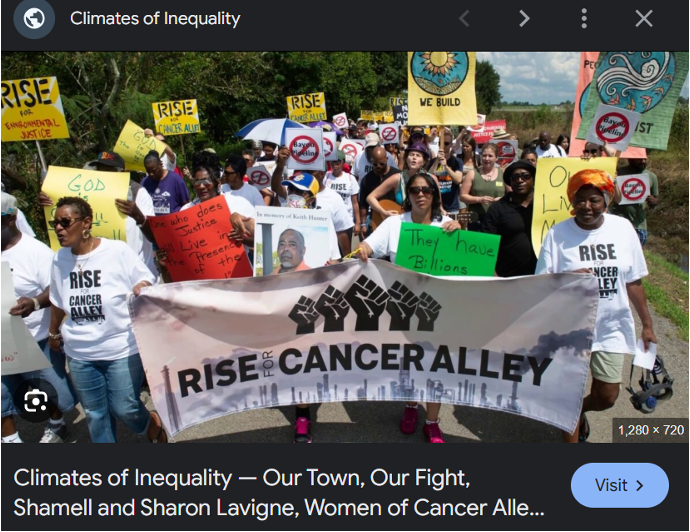
To ground this first aim of Black Ecologies, let’s analyze the powerful case study of Louisiana’s “Cancer Alley” which is located within an industrial stretch of the Mississippi River between the U.S. cities of Baton Rouge and New Orleans. Cancer Alley is a region with predominantly Black and working class communities and it is one of the most highly polluted areas in the US with some counties (also locally called ‘parishes’) with as many as ~13,000 cases of cancer. Despite this public health crisis, Louisiana continues to approve new plants and the expansion of existing ones.
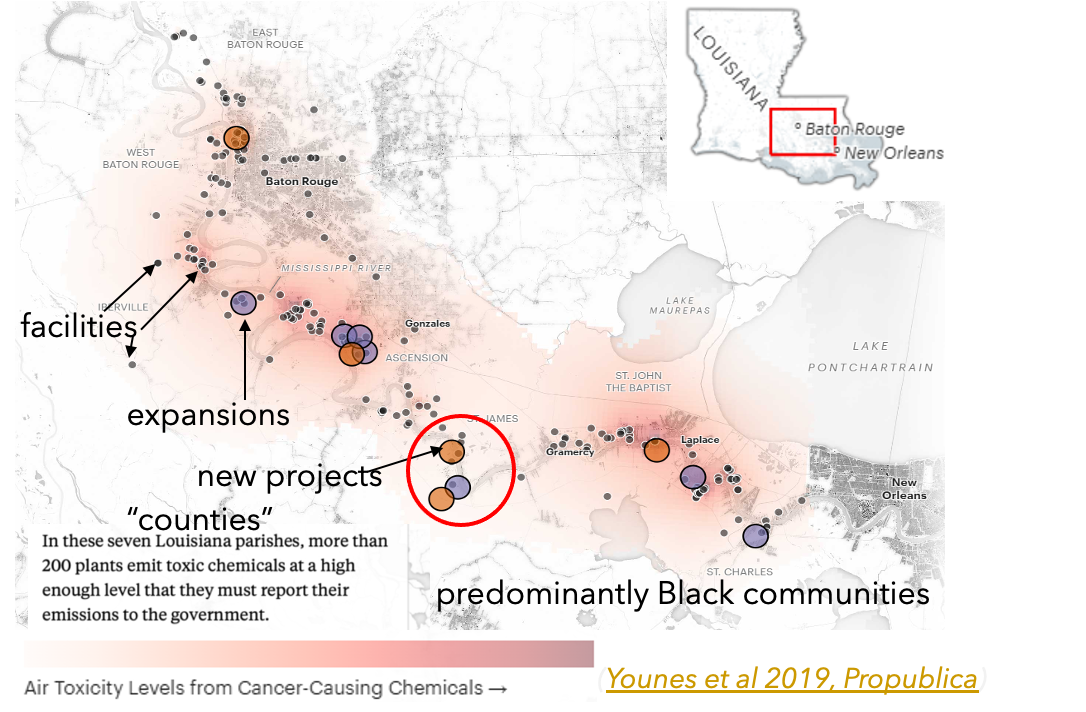
(Source: Younes et al 2019, Propublica)
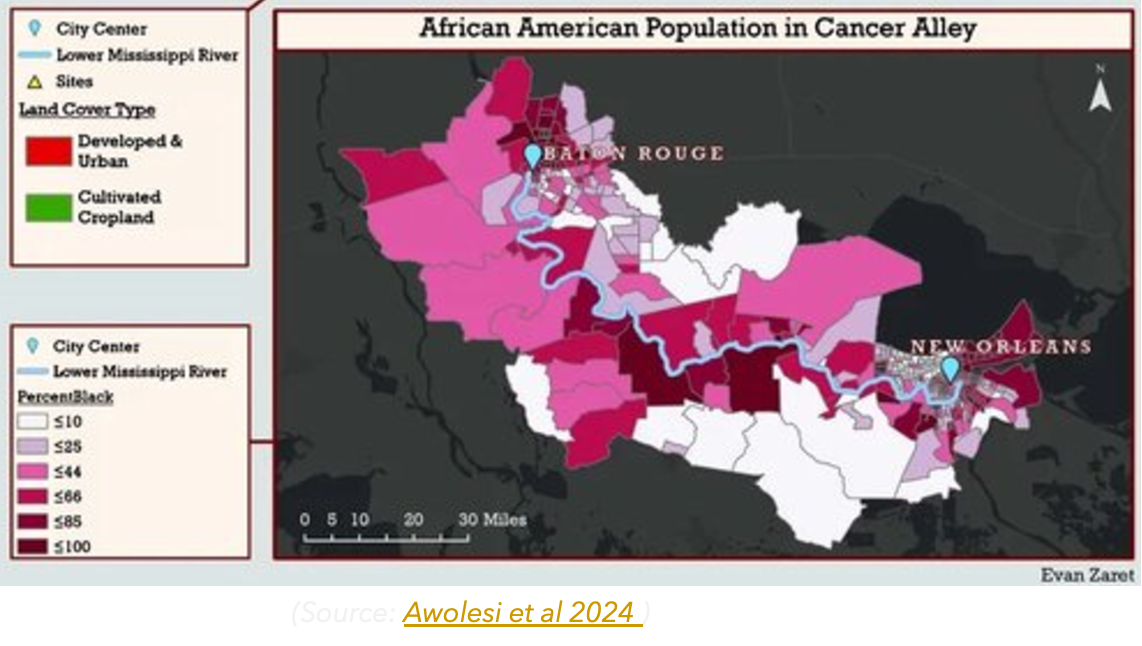
(Source: Awolesi et al 2024)
Studies show that Black people are 75% more likely to live near oil and gas refineries, and Black Americans face higher risks of premature death from power plant pollution (Fleischman and Franklin 2017) .
Consider the following questions:
1. At the end of the article, you are prompted to “Look up an address, ZIP code or landmark within East Baton Rouge, West Baton Rouge, Iberville, Ascension, St. James, St. Charles or St. John parishes to find how toxic the air is.” Go ahead and use this tool for a couple of locations and report on what you found.
2. Take a moment to search for organizing and actions that the affected communities have done to defend and protect themselves and their families? What has been the result?
3. Compare the two map images above. On the left, the map shows the location of existing and planned expansions or new power plant facilities. On the right, we see the percent of the population within each parish that is Black. What are some of the spatial patterns that you notice where overlaps do (or don’t) occur?
4. This propublica report was published in October 2019. See if you can find if any of the proposed new plants or plant expansions did indeed go into effect and what is the most recent news regarding this case.
5. How does this case study exemplify Black Ecologies?
6. Read the methodology for the analysis done at the link below.
https://www.propublica.org/article/how-we-found-new-chemical-plants-are-being-built-in-south-louisianas-most-polluted-areas
a) Write a summary of what you understand are the key parts of the methodology.
b) What is the difference between data obtained through a model and data obtained empirically?
c) Why is this study a powerful example of using an EPA model to promote change and justice?
d) What are the questions that arise for you?
Additional reading:
https://www.axios.com/local/chicago/2022/02/17/chicago-redlining-then-and-now
Fleischman and Franklin. 2017. Fumes Across the Fence Line: the health impacts of air pollution from oil and gas facilities on African American communities. NAACP & CATF Report: https://naacp.org/resources/fumes-across-fence-line-health-impacts-air-pollution-oil-gas-facilities-african-american
6.4 - NEED A TITLE FOR THIS PAGE
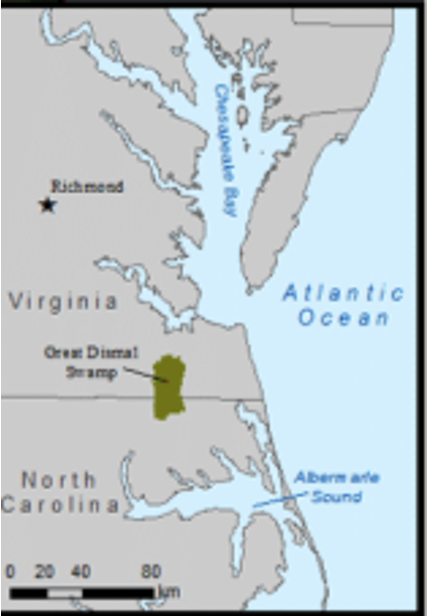
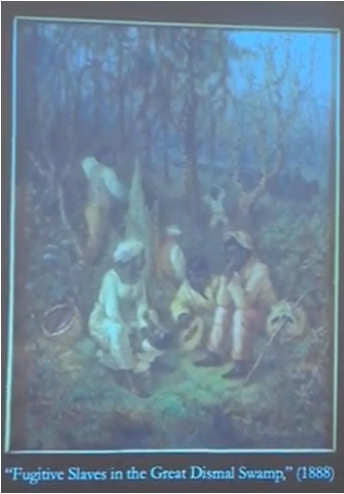
Another important aim of Black ecologies is to document insurgent and otherwise practices of Black eco-relations. Dr. Kathryn Benjamin Golden focuses on insurgent black ecologies that were essential to maroon communities, that is ‘fugitive’ people that escaped slavery in the 18th century, within in an area of the eastern so-called US known as the Great Dismal Swamp. This wetland area of over 2 km squared became home to thousands of maroons who rooted their lives as free people protected by the wilderness of the swamps for over two centuries.
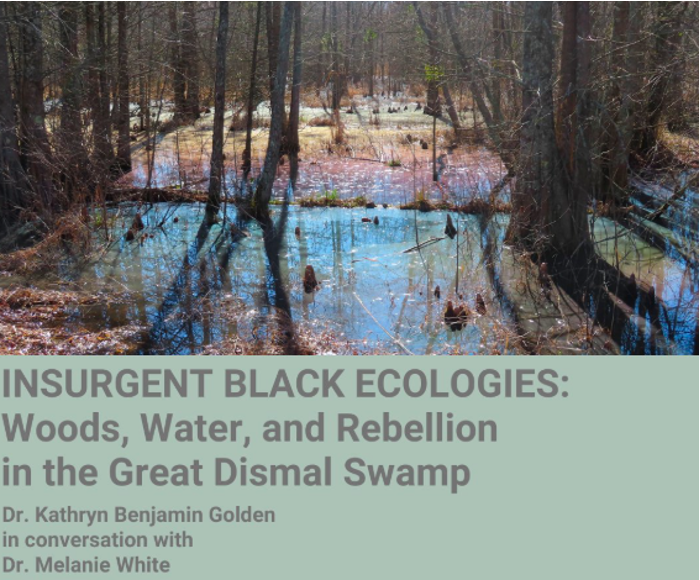

Read the section called “Trouble In The Water: Maroon Arrangements of an Insurgent Ecology by Kathryn Benjamin-Golden” in the Black Ecologies zine (all of it is amazing and highly recommended reading) at https://globalracialjustice.rutgers.edu/sites/default/files/2023-08/ISGRJ%20Blackecologies%208_17final.pdf
There is also a great recorded Sawyer seminar by Dr. Kathryn Benjamin Golden that you can check out if you want to learn more about her work at: Insurgent Black Ecologies: Woods, Water, and Rebellion in the Great Dismal Swamp
Consider the following questions in small groups:
- What is insurgent ecology?
- How is the history of maroonage in the Great Dismal Swamp an example of Black ecologies and sustainability?
- More contemporary forms and practices of insurgent ecologies continue with “Black diasporic communities continuing to plot against forms of ecological violence and domination through manifestation of the commons, maroon landscapes, the subterranean, the garden, and the cooperative. (T. Willams 2023)” Find an example of these practices by searching online or at a library for an organization or case study. Why did you select the one you did?
6.5 - NEED A TITLE FOR THIS PAGE
The last aim of Black ecologies examines how Black ecological knowledge(s) denote environmental futurities and build other-wise worlds in the here and now (Roane and Hosbey 2019; Williams 2021). At the heart of this aim is addressing the question ‘What realities and futurities do Black ecologies make possible?’
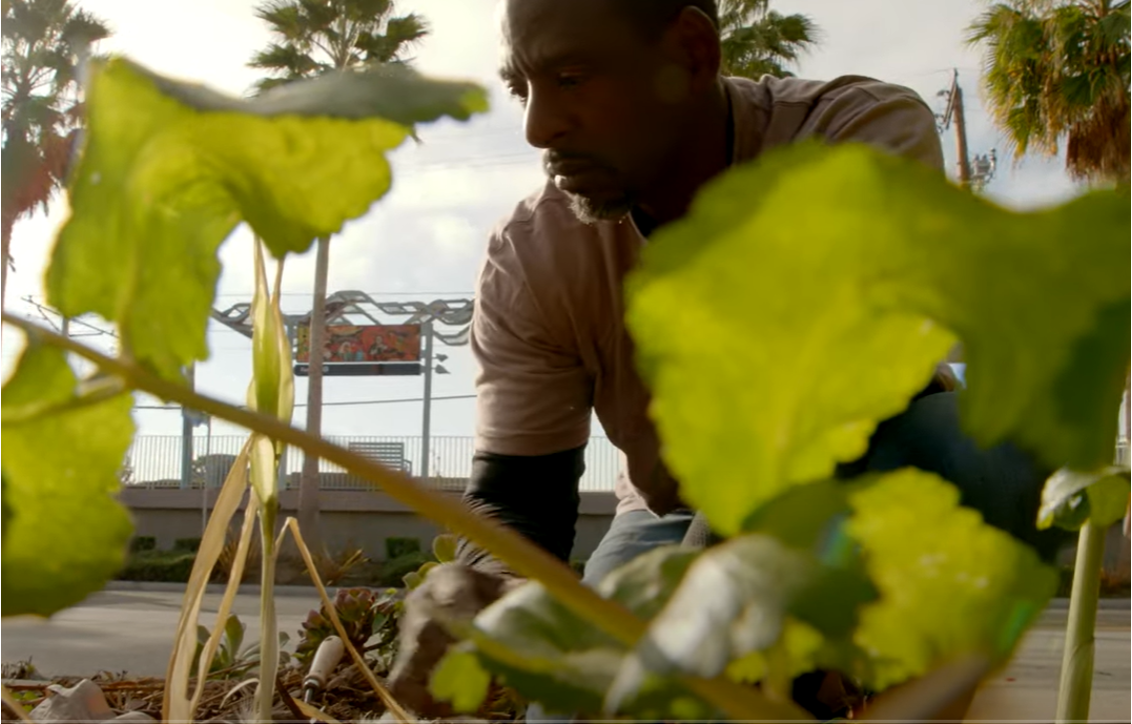
The story of Ron Finley, or ‘gansta gardner’, grounds Black ecologies within an urban reality. As a pillar of his community in L.A., Finley shares how he uses the soil as a canvas for gardening to provide nourishing food for his community and to seed food sovereignty – thereby challenging the racist food and health crisis that his community has faced by design.
Watch the TEDx talk - A guerilla gardener in South Central LA | Ron Finley
https://youtu.be/EzZzZ_qpZ4w?si=-3KndBvKftCioRDr
Consider the following questions:
- What does Ron Finley state the impact of gardening (getting kids to grow their own food) is on children?
- How is the work of Guerrilla gardening an example of Black ecologies and sustainability?
6.6 - NEED A TITLE FOR THIS PAGE - Lessons Learned with this Framework? (Maybe)
What are some of the challenges, critiques or lessons learned with this framework?
One of the critiques of Black Ecologies has been the overrepresentation of voices from the US-based context. Despite this, there has been increasing efforts to grasp the entwinements of Black Ecologies across the globe with a transnational or transterritorial lens where the experience of Black ecologies beyond the US Black diaspora opens up to the simultaneity of Black and Indigenous ecologies.
Just to mention a few collections where we see more global experiences of Black ecologies:
- The Black ecologies zine includes an account of the experiences of Afromexican@s of the Costa Chica region of southern Mexico who strive to sustain themselves from freshwater lagoons that have been subject to failed tourism waterway projects, as well as, toxic agrochemical runoff from oil-crop industries.
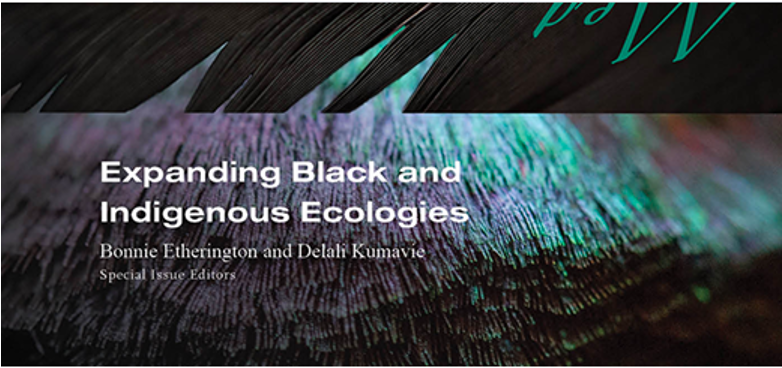
- The journal English Language Notes published a Special Issue that navigates the entwined histories of Black and Indigenous ecologies blurring territorial boundaries and expanding concepts of relationality. (Etherington and Kumavie 2024)

- The Black Pacific is another gleaming example of Black Ecologies captured through giants like native Black Pacific Islander Teresia Teaiwa (Teaiwa 2017), as well as, the millennial fire ecologies of Aboriginal peoples of so called ‘Australia’.

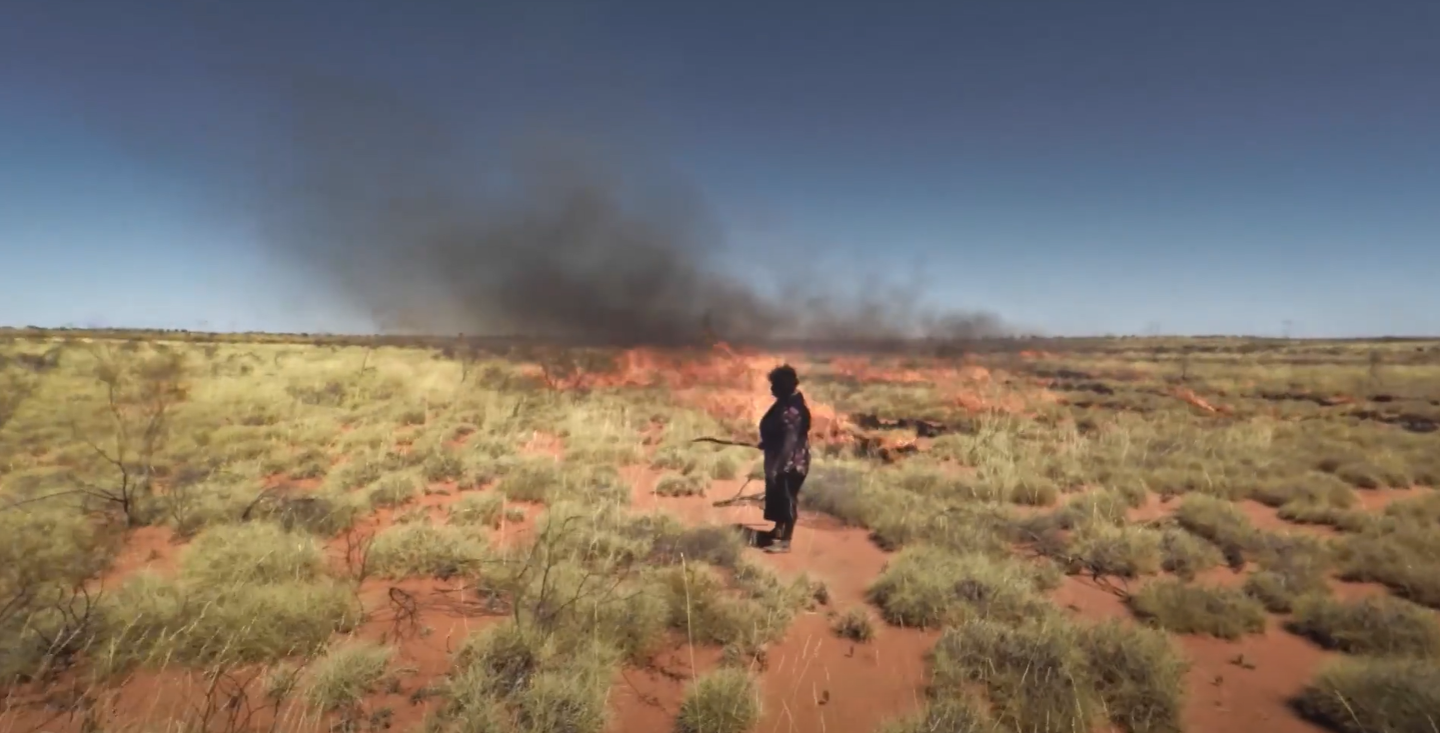
(Image is screenshot from SLICE short doc below)
Watch the following short video for a quick dive into Aboriginal fire ecologies.
How Aboriginal Australians use fire to help the ecosystem | SLICE (9:54 mins)
https://youtu.be/IXG7bSJxjIE
An additional good read is the following National geographic article “How Australia’s Aboriginal people fight fire – with fire”
- Positionality: What perspective is this video told from? Who is the intended audience?
- Positionality: How did you perceive that the different knowledge holders and practitioners are represented?
- What is the process of using fire ecology in this context (consider time of the year, size of areas targeted, who is involved, how long it takes, what plant communities are regenerated, how it affects the landscape, etc.)
- What benefits does Aboriginal fire ecology bring to people and to the environment? Are there any known drawbacks?
- What did you learn from Black fire ecologies that is new and how does it fit into or change your worldview?
Teaiwa, Teresia. “Black and Blue in the Pacific: Afro-Diasporic Women Artists on History and Blackness.” Amerasia Journal 43, no. 1 (2017): 145 –46.
6.7 - NEEDS A TITLE FOR THIS PAGE - Towards Collective Liberation? (Maybe)
Does this framework bring us closer towards collective liberation? How?
“Nobody’s free until everybody’s free” – Fanny Lou Hamer (Civil rights giant)
Liberation refers to the process of becoming free from oppression or control, while collective liberation recognizes the entanglement of multiple oppressions and argues that true freedom and well-being for any single person or group is impossible while other groups are oppressed. This view moves us past focusing on ‘individual liberties’ and recognizes the interdependence of multiple struggles, including more-than-human resistance. Collective liberation emphasizes that the health of the planet and the (in)justice of societies are deeply connected so that a deep commitment to dismantling oppressive systems that divide and dominate is required.
At its core, this last key guiding question invites us to envision an existence where uprisings that protect reciprocity, respect and responsibility with all beings on Earth can transition us away from perpetuating structures of oppression as we see with racial capitalism, extractivism, heteropatriarchy, white supremacy, genocide, ecocide, human supremacy, or where groups of beings are othered and sacrificed for the benefit of a particular group.
Black ecologies rises to the call for collective liberation by confronting historical and ongoing injustices and erasure while reconnecting with land, seeding generative ecological relationships, and building collective wellness rooted in a vibrant tradition of mutual aid and insurgent knowledge. By materializing futurities that value, respect and keep or rekindle traditions of subsisting and drawing sustenance from lands and waters locally, Black Ecologies aligns with lifeways that center fundamental necessities of a convivial existence and reject extensive overexploitation, extinction, pollution, and homogenization of the diverse tapestry of life. Through critical reflection and dialogue between Black ecologies and other critical sustainability frameworks, Black ecologies joins a global movement of collective liberation towards life-centered existences.
https://lifestyle.sustainability-directory.com/term/collective-liberation/
7 - CONCLUSION TITLE NEEDED HERE
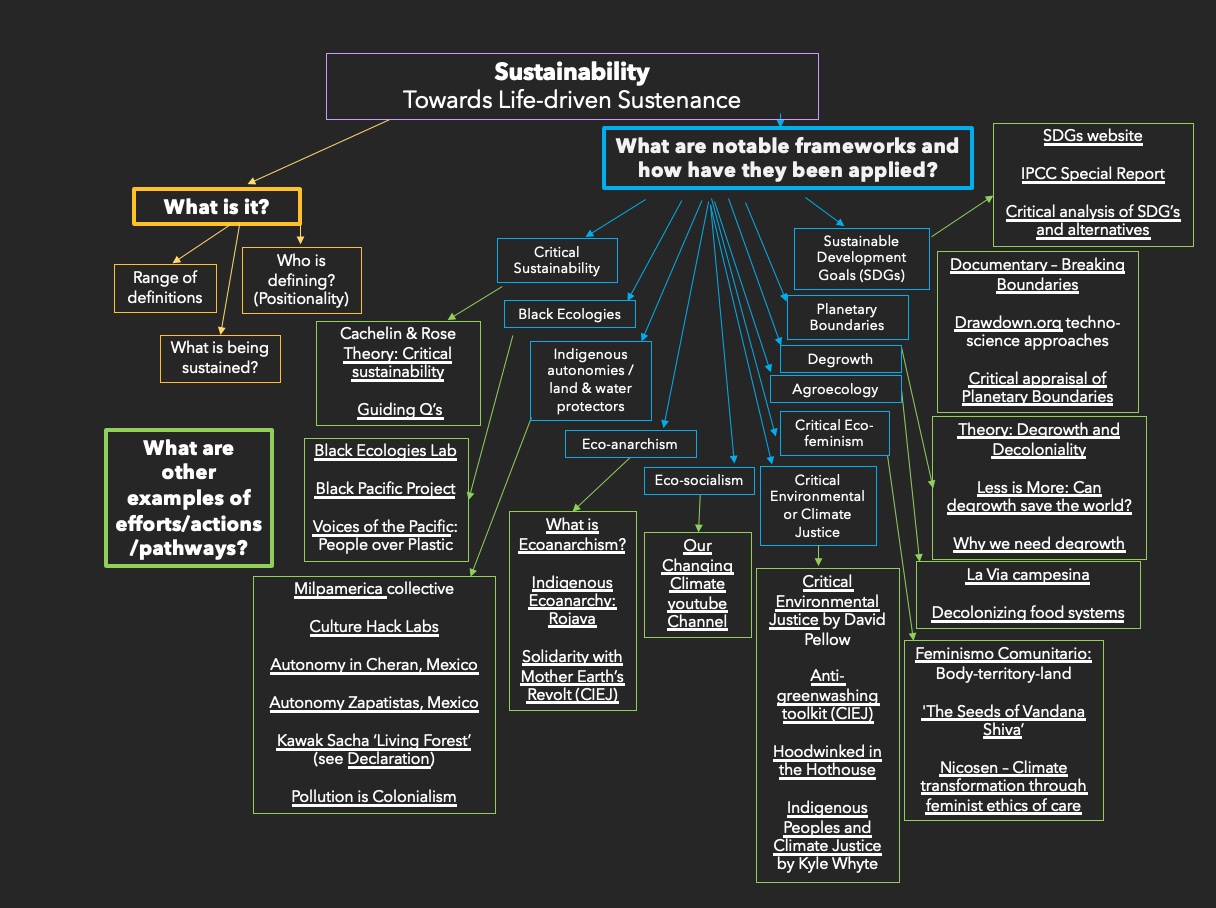
We have covered SDG’s, Planetary boundaries, and Black Ecologies. Let’s return to our concept map of sustainability towards sustenance.
As you can see there is a wide range of additional sustainability frameworks that are rising to the call for a profound transformation as we confront global environmental crises rooted in racial capitalism, patriarchy, extractivism, and domination of nature and people.
I invite you to continue your own personal exploration of these (and perhaps other) sustainability frameworks using the key guiding questions (refer to slide 7). (This needs to be changed)
Below I have embedded links that can propel your exploration of additional sustainability frameworks by orienting you towards examples, efforts, actions, and pathways. As you explore, I hope that you will be inspired and guided especially by the last key guiding question:
The statement above will have to be reworded, because the reader cannot click on the links in the grid. To make clickable links, a grid cannot be used.
Which of these frameworks brings us closer towards collective liberation and how?
Additional sources:
Indigenous Autonomies:
https://www.revistadelauniversidad.mx/articles/1d844a7f-318d-4f8d-9472-092d557d15d3/el-ezln-y-el-cni-en-la-defensa-del-territorio-y-de-la-madre-tierra
Critical Ecofeminisms:
https://avispa.org/lorena-cabnal-sanar-y-defender-el-territorio-cuerpo-tierra/