# Part 2: Cellular Reproduction and the Uterus
SHORT DESCRIPTION OF THE SECTION HERE
# Cellular Reproduction and the Uterus
How do reproductive organs reproduce? In order to continue existing, the cells must reproduce. But the types of reproduction differ greatly: as an organ system they undergo both mitosis and meiosis. Mitosis and meiosis primarily differ in the types of cells the process makes. In essence, mitosis reproduces cells that have the same number of chromosomes and serve the same function in the body. Meiosis produces more cells with only half the genetic information needed for the full future of the living organism. Tissues in the reproductive system can often reliably do both.
The traditionally recognized anatomy of the reproductive system for people who have uteri includes 1) the ovaries 2) the fallopian tubes 3) the uterus 4) the cervix and 5) the vulva. The ovaries make key hormones that affect both reproductive and non-reproductive health. They are also where eggs can be produced. There are often two ovaries about the size of 2 or 3 golf balls and are about ¾ of the way down the torso inside the abdomen. Fallopian tubes help connect the ovaries to the uterus. But they are not actually attached to both, only to the uterus. The uterus is a fist-sized pocket with a variable thickness of tissue on the outside. The cervix is a puffy ring of tissue about 1 inch thick and less than 2 inches wide. Finally the vulva, which has the vaginal opening, clitoris, labia minora and majora, opens to the outside of the body. See Figure 2.
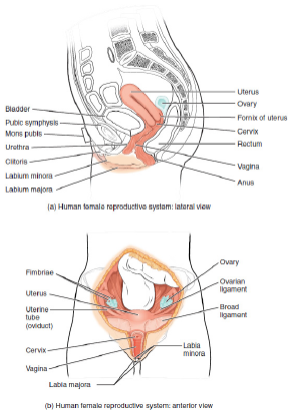
Figure 2: The anatomy of many people’s reproductive system includes key organs like the ovaries, Fallopian tubes, uterus, cervix and vagina. (Open Stax Anatomy and Physiology, 2e)
Some of the special proteins and chemicals that the reproductive system makes have huge impacts on the body. These can affect the body in ways that have nothing to do with making a new organism. The reproductive system also contains endocrine tissue made of cells that work to make hormones. Three key hormones produced by the ovaries can impact health completely unrelated to reproduction: estrogen, progesterone, and testosterone. There are also key proteins and cellular structures that can form in cycles and work together to make the new cells of the reproductive system.
Estrogen influences heart health, blood flow, sugar metabolism, bone growth and other key parts of the body unrelated to reproduction. Unlike other organ systems, it undergoes both mitosis and meiosis. It is sometimes given as a supplement for those experiencing acne, feeling negative impacts of menopause or if they need gender affirming care. It’s also targeted for reductions to treat certain cancer patients. Progesterone can affect new bone growth, blood pressure and brain function or mood. It is sometimes given as a drug for thyroid problems, to increase bone density, or, alongside estrogen, as a treatment for certain caners distinct from the reproductive system. Testosterone is also produced by ovaries. It helps increase bone density, muscle mass and red blood cell production.
In addition to sometimes being used to make new humans, the reproductive system must itself be reproduced if it will continue some of the non-reproductive activities listed above. Mitosis occurs in almost all cells in the body. It is a process that makes a single cell into a near-identical set of two cells. These cells are not always the same; mutations in the DNA inside chromosomes can occur that make new sequences and, occasionally, come with new traits.
The DNA in our chromosomes is almost the same in every cell in our body. But our cells do different things - cells in your eyeball produce photoreceptors to detect light. However, cells in our livers make proteins involved in breaking apart our food and filtering our blood. When mitosis happens, the information about which proteins to make and how many to make is usually carried forward into the new cell. The study of this is called epigenetics. This is why, despite having the same genome, liver cells make liver cells and not cells that detect light or send electricity to our nervous system for thinking and feeling. So even in mitosis both the DNA code and the information which parts of it should produce an effect, can change.
Meiosis, by contrast, uses mutations, epigenetics, and events that happen during division to make multiple unique cells. And unlike any other organ systems in our bodies, the reproductive system uses both types of animal cell division, mitosis and meiosis, to reproduce. This cellular replication is integrally related to the activities it can perform.
Before next class, please read the passage linked below on cellular reproduction. We will discuss the introduction above and the supplemental material in the next session.
[https://docs.google.com/document/d/1QNMaVL-nghQCnPsHWOFpAGyB0wrZhASyYaHZXspXkAk/edit?usp=sharing](https://docs.google.com/document/d/1QNMaVL-nghQCnPsHWOFpAGyB0wrZhASyYaHZXspXkAk/edit?usp=sharing)
# Discussion Questions for Part 2: Cellular Reproduction and the Uterus
**Discussion Questions**
1. Some forms of chemical birth control have both estrogen and progesterone. Others just have progesterone. After what you’ve read, which parts of the body do you think might be affected by these? How?
2. The ovaries often “take turns” producing a single ovum. And usually an ovary only produces one ovum per cycle. But sometimes both ovaries release ova or one ovaries makes two ova. This can lead to twins if fertilization occurs. Speculate about if these would be fraternal or identical twins. What does this have to do with the steps of meiosis?
3. Please make a concept map including the following terms: mitosis, meiosis I, meiosis II, haploid, diploid, mutation, genetic diversity, centromere, sister chromatid, homologous chromosomes, mitotic spindle.
4. A grain of pollen is a gamete, haploid. But it is able to divide to form a pollen tube to reach the ovule to make a seed. How is the creation of a pollen tube different from a plant growing a new leaf? How is it the same? What would it be like if animals had gametes that could do this?