# Part 4: The Experience of Having a Uterus as a Non-Woman
SHORT DESCRIPTION OF THE SECTION HERE
# The Experience of having a Uterus as a Non-Woman
We explored the word “should” with respect to uteri in the previous section. Now we can delve into “woman”. This module has not used that word frequently. The articles on reproductive justice used the words “childbearing women” to mean people who had uteri and ovulated on a predictable basis allowing possible fertilization - in some people’s minds, a "working uterus”. We avoided that phrasing. But beyond possible processes that could occur from and in a uterus, we also need to make space for a discussion of people who have this organ and are not women. They have diverse lived experiences, especially interactions with the medical community, that are distinct and deserve discussion.
Many people, around two percent of the population depending on the details of the definition, are intersex. Intersex is a term that describes people whose bodies do not directly fit into the medical expectations of either male or female bodies. This term can encompass the variability found in hormones, external and internal organs or structures, and the chromosomes that are associated with sexual characteristics among humans. Among intersex people with a uterus, anatomy and activity varies as well. Some people also have testes, or lack ovaries. Some ovulate but don’t menstruate, others menstruate regularly. These people with uteri are left out of biology textbooks or mentioned as disorders or syndromes - problems to be “fixed”.
Another group of people with uteri are non-binary or gender non-conforming. The distinction between gender and sex should be examined, while noting that sex isn’t just two categories. Sex is a reflection of hormonal, anatomical and chromosomal variation while gender encompasses behavior, expression, identity and societal expectations and experiences. While sex does have a social component, e.g. what is defined as a functioning uterus or the history of how the anatomy was described, gender is primarily a social construct. Biology can impact the social beyond the assignment of gender at birth - some women who have hysterectomies feel less “like a woman”. And gender can impact biology; there are sometimes physiological consequences to the social experience of being treated as the wrong gender by those around you.
Although some intersex and gender non-conforming people, as well as transgender men, may have uteri, their experiences are influenced by the scientific community’s ideas about uteri, sex, and gender in distinct ways. Here we will focus primarily on the interactions of men who were assigned as female at birth but we encourage learners to explore the topic more broadly.
Some care for transmen or transmasculine people is not related to their sex but instead their gender when compared to cis people. The 2010 National Transgender Discrimination Survey (NTDS) found that trans or gender diverse people reported profound negative interactions in health care settings. Half of the respondents said their health care providers lack knowledge of their needs, almost 30% experienced harassment. 20% of people who were assigned female at birth were refused the requested care. Although additional barriers to care, such as cost and local access are essential components of the conversation, they are beyond the scope of this module. We encourage learners to explore those topics independently.
Specific requests related to gender affirming care, including hormone treatments, surgeries and other procedures, show a stark gap between what transmen want and what they have received. According to the 2022 United States Trans Survey (USTS), the greatest gap between transmen’s medical histories and the procedures or surgeries desired was found in examining hysterectomies.
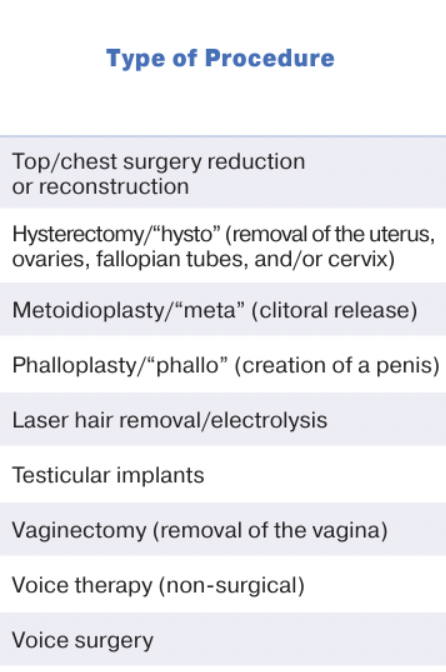
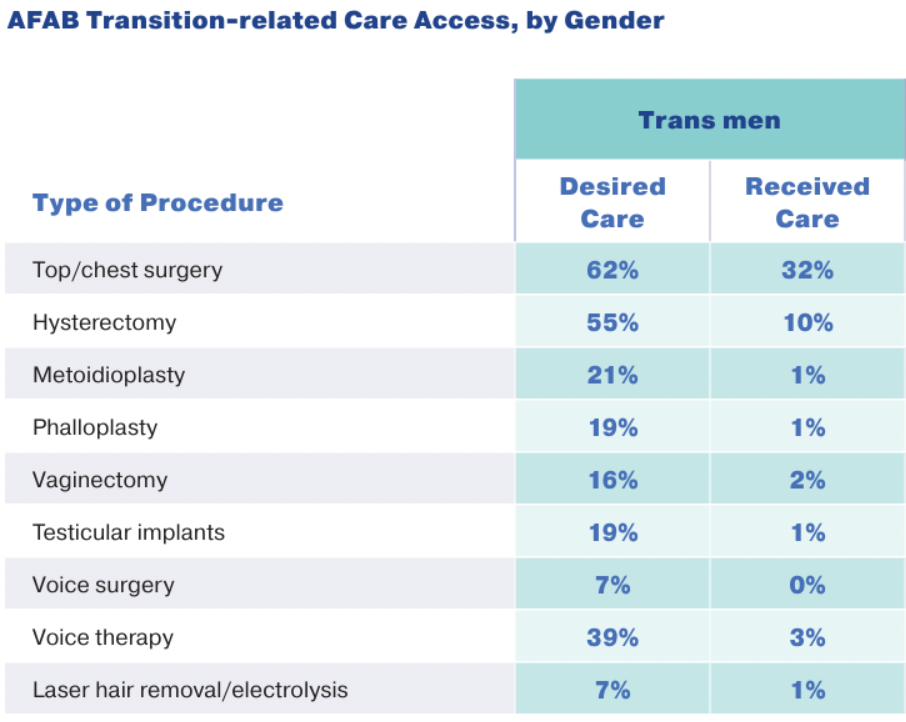
Figure 4: Gaps between medical histories and aspirations for transmen
Anxiety among transmen about receiving gynecological care is staggering: 92% according to a 2018 study by Fecker et al. Physical or emotional distress were the most common reasons given for avoiding this type of care altogether. One of the most common experiences when visiting a gynecologist is a pelvic exam. The pelvic exam is primarily used for early detection of cancer or sexually transmitted infections, although there are laboratory-based tests that can detect many of these.
Pelvic exams involve removing clothing and putting on a gown followed by placing your feet in two stirrups around three or four feet above the ground and approximately two feet apart. The physician inserts a speculum, a metal device a bit like a bird beak, to open up the vaginal walls and look at the cervix. They usually take a scraping of the cells to check for cervical cancer. Then the doctor inserts fingers through the cervix and presses on the area where the uterus and ovaries might be on the outside of the pelvis. This is to detect changes in size, motion or hardness in these organs that may indicate gynecological problems. Many people who have hysterectomies are not asked to have pelvic exams.
In a 2022 study, Pulice-Farrow, et al. found that more than 60% of tranmasculine people experienced indirect or subtle discrimination from doctors during a pelvic exam. These fell into themes that respondents associated with their experience. The most common was a failure to acknowledge or respect their gender.

Figure 5: themes identified in discriminatory experience for transmen seeing gynecological health care
Transmen also struggle with healthcare related to pregnancy. Transmen who decide to gestate a fetus using either their own or other people's ova encounter numerous barriers, well beyond the expense. Gestating a fetus involves hormone levels that are sometimes different from how people want to live under other circumstances. Finding gender-affirming pre-natal care can be a significant challenge - the discussion of “women” and “mothers” is everywhere in dialog and even physical spaces that provide these services. In a 2020 review, Besse et al. noted, ”While providers may not receive the necessary training during medical school, this should not allow them to deny transgender patients or provide them with a lower level of care. The medical education system needs to ensure training on transgender health is included, but until these changes are implemented, providers need to educate themselves to improve transgender patients’ experiences.”
Despite the challenges, and much like some cis-gendered people, many transmen define their pregnancy and birth experiences as very fulfilling. One transman included in a study by Amesford et al. in 2023 said ““I thought: ‘At last, I am pregnant!’... I am proud to be carrying a child.” We encourage people who want a deeper exploration of the topic, including but not limited to transmen or health, to read Erickson-Schroth, L. (Ed.). (2022). Trans bodies, trans selves: A resource by and for transgender communities. Oxford University Press.
Before next class, please listen to the podcast linked below on the experiences related to being intersex and the excerpt from an interview of a researcher on tranemen and parenting. We will discuss the introduction above and the supplemental material in the next session. For transcription services of the mp3, we recommend Otter.ai.
[https://www.npr.org/2023/06/30/1185520439/documentary-every-body-centers-the-lives-and-activism-of-intersex-people](https://www.npr.org/2023/06/30/1185520439/documentary-every-body-centers-the-lives-and-activism-of-intersex-people)
[https://babblery.com/wp-content/uploads/2023/06/BabbleryTransmascCOMPACT\_mixdown.mp3](https://babblery.com/wp-content/uploads/2023/06/BabbleryTransmascCOMPACT_mixdown.mp3)
# Discussion Questions for Part 4: The Experience of having a Uterus as a Non-Woman
**Discussion Questions**
1. Before this module, what information did you have about intersex people? Where did it come from? What information did you have about trans people? Where did it come from?
2. Why do you think dominant narratives pose the existence intersex people as a “problem” that needs “fixing”?
3. Gynecologists have a medical degree - they are Dr. X, the “expert”. What, if any, effect does the prestige of being a doctor have on their interactions? Does this vary based on the identity of the patient? Why is that the case?
4. Researcher and activist Vann Jones, says “My doctor doesn’t know this stuff” and this means “I can’t make safe and informed decisions”. Have you or someone you know ever felt that way? What were those experiences like?
5. What does he mean when he says “biological essentialism”? What feels helpful or unhelpful about that framework?
6. Jones notes that a lot of gynecological care “dehumanizes the person carrying the child”. He sees this as something experienced by men and women. How does this observation interact with the reading from Federici? How does it inform the podcast from Dr. Roberts?