[https://mronline.org/2020/11/03/the-past-as-prologue-caliban-the-witch-a-review/](https://mronline.org/2020/11/03/the-past-as-prologue-caliban-the-witch-a-review/)
# Discussion Questions for Part 1: The History of the Study of Uteri **Discussion Questions** 1. What do you think those who believed in the “wandering uterus” diagnosis felt were the “wrong” results of having a uterus? Do you think there are echoes of that idea now - a “right” and “wrong” way to use a uterus? 2. Why do you think sexual pleasure for those with uteri was considered impossible in some ancient times? 3. Have you experienced or heard about experiences with medical professionals involving uteri? What were those like for the patient? 4. Between 30-50% of those with endometriosis struggle with fertility. How does this statistic interact with question 1 about the “use” of a uterus? 5. What is convincing about the thesis for Federici about reproductive control and witch hunts? What doesn’t make sense to you? 6. We hear in the news about labor shortages in certain economic sectors. What does reproduction and maintaining the workforce look like now? Does it relate to anti-immigrant sentiment? If so, how? # Part 2: Cellular Reproduction and the Uterus SHORT DESCRIPTION OF THE SECTION HERE # Cellular Reproduction and the Uterus How do reproductive organs reproduce? In order to continue existing, the cells must reproduce. But the types of reproduction differ greatly: as an organ system they undergo both mitosis and meiosis. Mitosis and meiosis primarily differ in the types of cells the process makes. In essence, mitosis reproduces cells that have the same number of chromosomes and serve the same function in the body. Meiosis produces more cells with only half the genetic information needed for the full future of the living organism. Tissues in the reproductive system can often reliably do both. The traditionally recognized anatomy of the reproductive system for people who have uteri includes 1) the ovaries 2) the fallopian tubes 3) the uterus 4) the cervix and 5) the vulva. The ovaries make key hormones that affect both reproductive and non-reproductive health. They are also where eggs can be produced. There are often two ovaries about the size of 2 or 3 golf balls and are about ¾ of the way down the torso inside the abdomen. Fallopian tubes help connect the ovaries to the uterus. But they are not actually attached to both, only to the uterus. The uterus is a fist-sized pocket with a variable thickness of tissue on the outside. The cervix is a puffy ring of tissue about 1 inch thick and less than 2 inches wide. Finally the vulva, which has the vaginal opening, clitoris, labia minora and majora, opens to the outside of the body. See Figure 2. 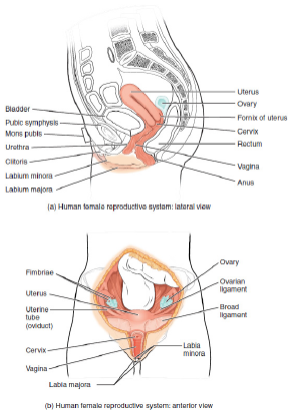 Figure 2: The anatomy of many people’s reproductive system includes key organs like the ovaries, Fallopian tubes, uterus, cervix and vagina. (Open Stax Anatomy and Physiology, 2e) Some of the special proteins and chemicals that the reproductive system makes have huge impacts on the body. These can affect the body in ways that have nothing to do with making a new organism. The reproductive system also contains endocrine tissue made of cells that work to make hormones. Three key hormones produced by the ovaries can impact health completely unrelated to reproduction: estrogen, progesterone, and testosterone. There are also key proteins and cellular structures that can form in cycles and work together to make the new cells of the reproductive system. Estrogen influences heart health, blood flow, sugar metabolism, bone growth and other key parts of the body unrelated to reproduction. Unlike other organ systems, it undergoes both mitosis and meiosis. It is sometimes given as a supplement for those experiencing acne, feeling negative impacts of menopause or if they need gender affirming care. It’s also targeted for reductions to treat certain cancer patients. Progesterone can affect new bone growth, blood pressure and brain function or mood. It is sometimes given as a drug for thyroid problems, to increase bone density, or, alongside estrogen, as a treatment for certain caners distinct from the reproductive system. Testosterone is also produced by ovaries. It helps increase bone density, muscle mass and red blood cell production. In addition to sometimes being used to make new humans, the reproductive system must itself be reproduced if it will continue some of the non-reproductive activities listed above. Mitosis occurs in almost all cells in the body. It is a process that makes a single cell into a near-identical set of two cells. These cells are not always the same; mutations in the DNA inside chromosomes can occur that make new sequences and, occasionally, come with new traits. The DNA in our chromosomes is almost the same in every cell in our body. But our cells do different things - cells in your eyeball produce photoreceptors to detect light. However, cells in our livers make proteins involved in breaking apart our food and filtering our blood. When mitosis happens, the information about which proteins to make and how many to make is usually carried forward into the new cell. The study of this is called epigenetics. This is why, despite having the same genome, liver cells make liver cells and not cells that detect light or send electricity to our nervous system for thinking and feeling. So even in mitosis both the DNA code and the information which parts of it should produce an effect, can change. Meiosis, by contrast, uses mutations, epigenetics, and events that happen during division to make multiple unique cells. And unlike any other organ systems in our bodies, the reproductive system uses both types of animal cell division, mitosis and meiosis, to reproduce. This cellular replication is integrally related to the activities it can perform.Before next class, please read the passage linked below on cellular reproduction. We will discuss the introduction above and the supplemental material in the next session.
[https://docs.google.com/document/d/1QNMaVL-nghQCnPsHWOFpAGyB0wrZhASyYaHZXspXkAk/edit?usp=sharing](https://docs.google.com/document/d/1QNMaVL-nghQCnPsHWOFpAGyB0wrZhASyYaHZXspXkAk/edit?usp=sharing)
# Discussion Questions for Part 2: Cellular Reproduction and the Uterus **Discussion Questions** 1. Some forms of chemical birth control have both estrogen and progesterone. Others just have progesterone. After what you’ve read, which parts of the body do you think might be affected by these? How? 2. The ovaries often “take turns” producing a single ovum. And usually an ovary only produces one ovum per cycle. But sometimes both ovaries release ova or one ovaries makes two ova. This can lead to twins if fertilization occurs. Speculate about if these would be fraternal or identical twins. What does this have to do with the steps of meiosis? 3. Please make a concept map including the following terms: mitosis, meiosis I, meiosis II, haploid, diploid, mutation, genetic diversity, centromere, sister chromatid, homologous chromosomes, mitotic spindle. 4. A grain of pollen is a gamete, haploid. But it is able to divide to form a pollen tube to reach the ovule to make a seed. How is the creation of a pollen tube different from a plant growing a new leaf? How is it the same? What would it be like if animals had gametes that could do this? # Part 3: The Social Context for Who “Should” Use This Organ in the Context of White Supremacy SHORT DESCRIPTION OF THE SECTION HERE # The Social Context for Who “Should” Use This Organ in the Context of White Supremacy In the previous section, we tried to avoid saying things like “the function of a uterus is” or “normally, the egg matures”. Instead we attempted to frame things with a range of possibilities. We did this because we reject discussions of reproduction in biology that tend to use a “should” framework. A uterus should be able to gestate a fetus; if it doesn’t, it is sick. We also did this because the uterus is a part of the body of a person - a person who has independent actions and ideas but also lives in a social context. As part of our ongoing theme of the uterus as a special organ we should examine societal ideas about the appropriate “uses” of the organ for different people. Again, notice here that there are no laws, government policies or corporate campaigns that regulate the use of your pancreas or thalamus. The premise that uteri “should” be used to make children is not universal. This “should” varies throughout history, by the country in question and by individual identities. Examples of times when people with uterus were strongly encouraged or even forced to have more children are numerous. In Nazi Germany, people who were considered genetically “fit”, received marriage loans and birth grants to encourage large families. The judgement of humans is more or less genetically fit is called eugenics and has been practiced in various forms all over the world. In Germany, this eugenicist campaign was occurring side by side with the Holocaust and murder of approximately 1.5 million children deemed “unfit”. In the Americas and Caribbean, enslaved Africans were punished, even up to death, for refusing to bear children who the enslaver considered his valuable property. Less extreme examples can be found in many countries where people argue for increasing childbirth for moral, religious, or demographic reasons. Discussions of how certain nations are “dying out” while other nations are “overpopulated” are common in Europe and the United States. These can sometimes correspond to government-sponsored financial incentives or used as justification for limiting access to birth control or abortion. The encouragement to have more children inside the context of a family is sometimes called pro-natalist or simply natalist. Discouraging or disapproving of childbirth is called anti-natalism. Two examples may be familiar. There are people who argue overpopulation and ecological collapse means it is irresponsible to birth more babies. You may also know about the policy once implemented in China called the “one child policy”. Less known is the policy in British-occupied Hong Kong where government health officials created a campaign to limit all families to only two children. Similar ones were implemented in Iran and India as well. In India, cash bonuses were given to couples who delayed having children. Financial incentives are widely considered coercive because they disproportionately target low income and working class people. Sometimes anti-natalist policies involve forced sterilization. Methods can include a hysterectomy, either removal of the uterus or also the ovaries, or a tubal ligation. This procedure can allow ovulation but prevents the ova from reaching the uterus. 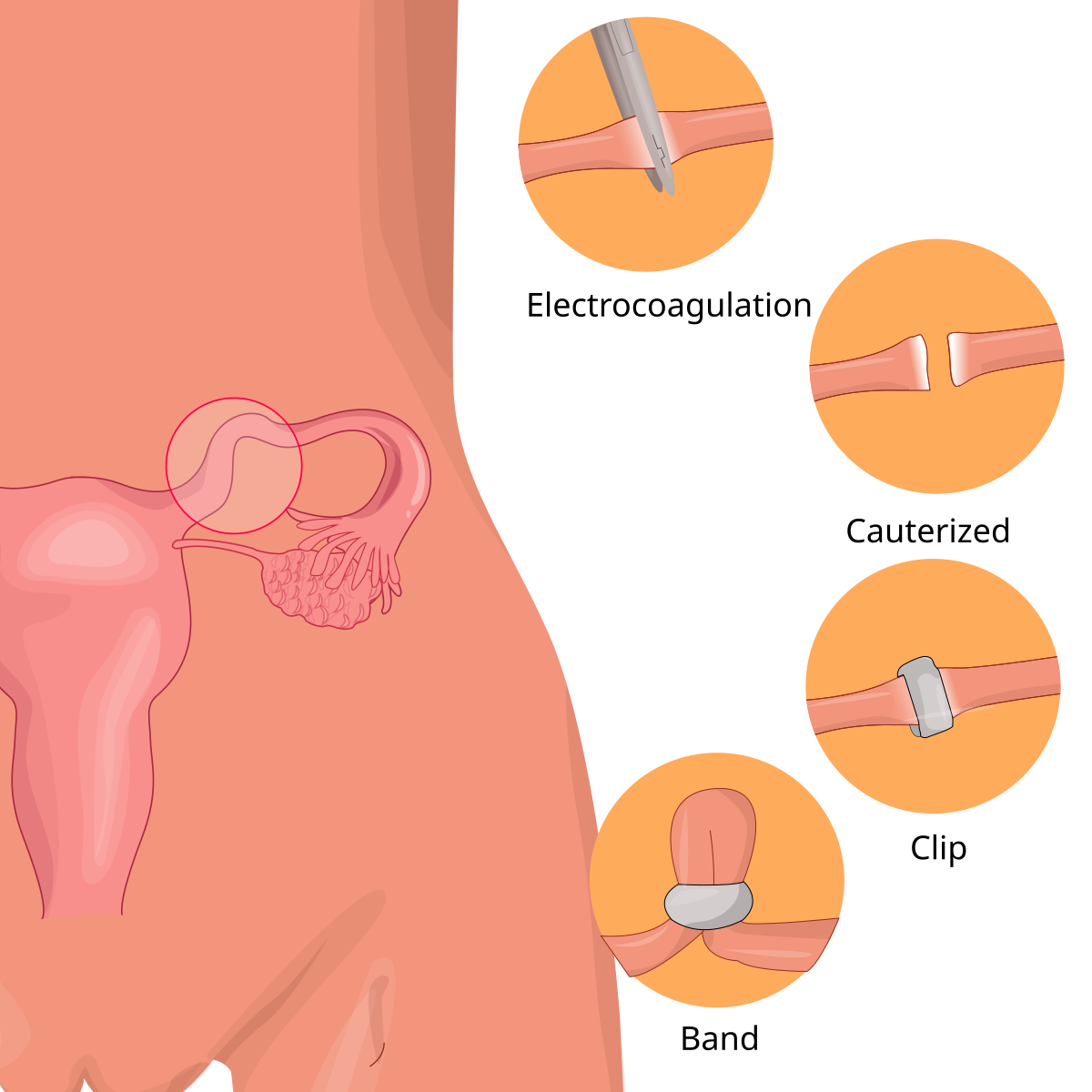 Figure 3: Tubal ligations involve one of the following four methods carried out on Fallopian tubes: an electrode is used to block blood flow, heat used to sever, or clips or bands used to block the passage of ova. In 2022, a comparative study of forced sterilization was published by Rolands and Regmi. They write, “With an anti-natalist government policy framework in place, roughly one-third to one-half of candidates have been sterilized without valid consent”. In Puerto Rico, a law was passed in 1937 that opened free sterilization clinics which were overseen by a famous American eugenicist, Dr. Clarence Gamble. By the 1950s, nearly one-third of people who might have used their uterus to gestate a fetus had been sterilized. This frequently occurred through coercion involving economic incentives, conditions for employment, or direct deception about if the procedure was reversible. As recently as 2020, a nurse in an Immigration and Customs Enforcement detention facility became a whistle-blower about medical neglect. About the doctor she called “the uterus collector”, she said, “Everybody he sees has a hysterectomy—just about everybody.” In the context of the United States, people with uteri receive deeply different messages and have profoundly different interactions with the state and medical community about if they “should” have children. Although outside of the scope of this module, there are also very disparate systems for if parents are allowed to rear the children they have. Examples include the foster care system as well as the boarding school system used on indigenous communities. We encourage learners to explore this topic independently. Earlier we noted uteri exist inside bodies of people - people who have independent actions and ideas but also live in a social context. The actions that have been taken by people with uteri who have experienced this part of a social context have been monumental. From the Sojourner Truth speech “Ain’t I a woman?’, to the Comahee River Collective, to the work of scholars like Dr. Dorothy Roberts (see below), resistance and resilience are an equal part of the social context for some people with uteri. Before next class, please listen to the podcast linked below on types of reproductive control implemented against Black women. We will discuss the introduction above and the supplemental material in the next session. For transcription services of the mp3, we recommend Oter.ai.[https://www.science.org/doi/10.1126/science.adj1265](https://www.science.org/doi/10.1126/science.adj1265)
# Discussion Questions for Part 3: The Social Context for Who “Should” Use This Organ in the Context of White Supremacy **Discussion Questions** 1. The title of this section includes the phrase “white supremacy”. How would you define this term? Do you think it applies to the information here? Why or why not? 2. Those who have learned about Eugenics think of it primarily within the context of Nazi Germany. However, it is older, founded by a contemporary of Darwin, Francis Galton. And its popularity spanned the globe, including many famous US biologists and medical professionals. What was happening in the US within that time frame (1890-1930) that might have made this an attractive idea to those sectors of society? 3. What have you heard about overpopulation? What does the word mean to you in the context of the US versus nations in the Global South (formerly called Third-World countries)? 4. What is the Mississippi appendectomy? Black women have a maternal mortality rate of 50.3 deaths per 100k live births while it was 14.5 for white women. How does that history interact with the “Mississippi appendectomy”? 5. Do you think the history behind birth control in non-White communities still influences people? If so, how? 6. Simply based on the introduction to the module and Dr. Robert’s podcast, how would you define “racialized capitalism”? Does that firework make sense to you? Why or why not? 7. Some people use the words “reproductive rights” and others talk about “reproductive justice”. What, if any, difference do you see? 8. What pressures, if any, do you, or people with a uterus who you know, feel about how a uterus “should” be used? Where could this pressure come from? Why do you think it might occur? # Part 4: The Experience of Having a Uterus as a Non-Woman SHORT DESCRIPTION OF THE SECTION HERE # The Experience of having a Uterus as a Non-Woman We explored the word “should” with respect to uteri in the previous section. Now we can delve into “woman”. This module has not used that word frequently. The articles on reproductive justice used the words “childbearing women” to mean people who had uteri and ovulated on a predictable basis allowing possible fertilization - in some people’s minds, a "working uterus”. We avoided that phrasing. But beyond possible processes that could occur from and in a uterus, we also need to make space for a discussion of people who have this organ and are not women. They have diverse lived experiences, especially interactions with the medical community, that are distinct and deserve discussion. Many people, around two percent of the population depending on the details of the definition, are intersex. Intersex is a term that describes people whose bodies do not directly fit into the medical expectations of either male or female bodies. This term can encompass the variability found in hormones, external and internal organs or structures, and the chromosomes that are associated with sexual characteristics among humans. Among intersex people with a uterus, anatomy and activity varies as well. Some people also have testes, or lack ovaries. Some ovulate but don’t menstruate, others menstruate regularly. These people with uteri are left out of biology textbooks or mentioned as disorders or syndromes - problems to be “fixed”. Another group of people with uteri are non-binary or gender non-conforming. The distinction between gender and sex should be examined, while noting that sex isn’t just two categories. Sex is a reflection of hormonal, anatomical and chromosomal variation while gender encompasses behavior, expression, identity and societal expectations and experiences. While sex does have a social component, e.g. what is defined as a functioning uterus or the history of how the anatomy was described, gender is primarily a social construct. Biology can impact the social beyond the assignment of gender at birth - some women who have hysterectomies feel less “like a woman”. And gender can impact biology; there are sometimes physiological consequences to the social experience of being treated as the wrong gender by those around you. Although some intersex and gender non-conforming people, as well as transgender men, may have uteri, their experiences are influenced by the scientific community’s ideas about uteri, sex, and gender in distinct ways. Here we will focus primarily on the interactions of men who were assigned as female at birth but we encourage learners to explore the topic more broadly. Some care for transmen or transmasculine people is not related to their sex but instead their gender when compared to cis people. The 2010 National Transgender Discrimination Survey (NTDS) found that trans or gender diverse people reported profound negative interactions in health care settings. Half of the respondents said their health care providers lack knowledge of their needs, almost 30% experienced harassment. 20% of people who were assigned female at birth were refused the requested care. Although additional barriers to care, such as cost and local access are essential components of the conversation, they are beyond the scope of this module. We encourage learners to explore those topics independently. Specific requests related to gender affirming care, including hormone treatments, surgeries and other procedures, show a stark gap between what transmen want and what they have received. According to the 2022 United States Trans Survey (USTS), the greatest gap between transmen’s medical histories and the procedures or surgeries desired was found in examining hysterectomies. 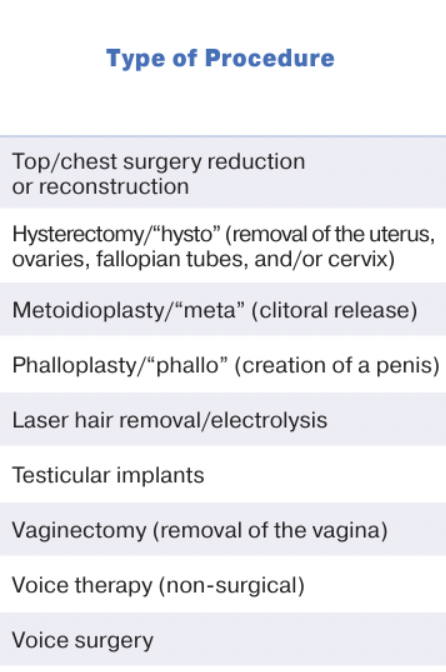 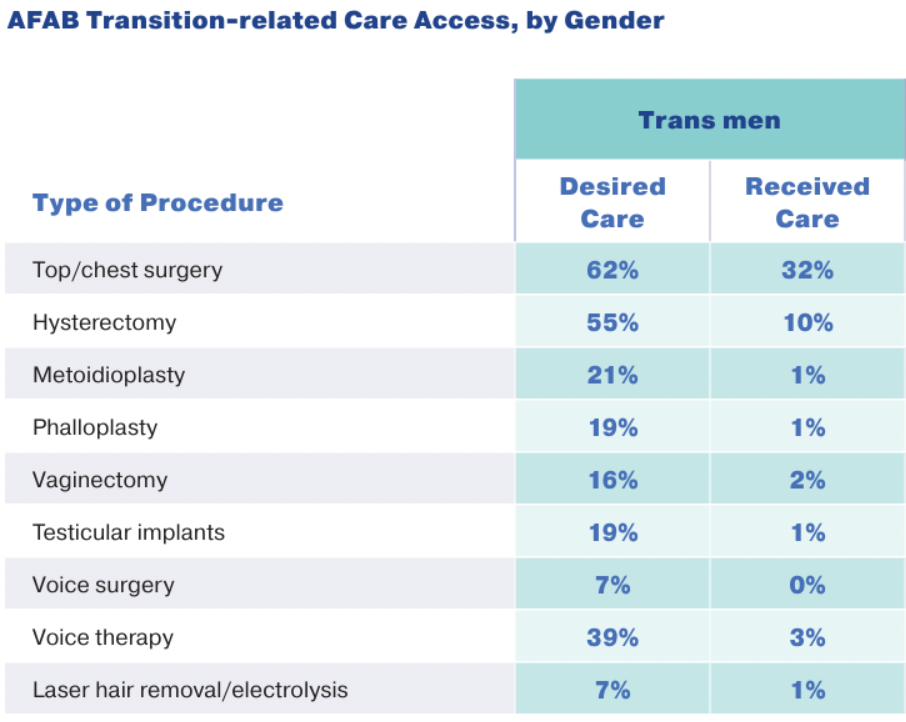 Figure 4: Gaps between medical histories and aspirations for transmen Anxiety among transmen about receiving gynecological care is staggering: 92% according to a 2018 study by Fecker et al. Physical or emotional distress were the most common reasons given for avoiding this type of care altogether. One of the most common experiences when visiting a gynecologist is a pelvic exam. The pelvic exam is primarily used for early detection of cancer or sexually transmitted infections, although there are laboratory-based tests that can detect many of these. Pelvic exams involve removing clothing and putting on a gown followed by placing your feet in two stirrups around three or four feet above the ground and approximately two feet apart. The physician inserts a speculum, a metal device a bit like a bird beak, to open up the vaginal walls and look at the cervix. They usually take a scraping of the cells to check for cervical cancer. Then the doctor inserts fingers through the cervix and presses on the area where the uterus and ovaries might be on the outside of the pelvis. This is to detect changes in size, motion or hardness in these organs that may indicate gynecological problems. Many people who have hysterectomies are not asked to have pelvic exams. In a 2022 study, Pulice-Farrow, et al. found that more than 60% of tranmasculine people experienced indirect or subtle discrimination from doctors during a pelvic exam. These fell into themes that respondents associated with their experience. The most common was a failure to acknowledge or respect their gender.  Figure 5: themes identified in discriminatory experience for transmen seeing gynecological health care Transmen also struggle with healthcare related to pregnancy. Transmen who decide to gestate a fetus using either their own or other people's ova encounter numerous barriers, well beyond the expense. Gestating a fetus involves hormone levels that are sometimes different from how people want to live under other circumstances. Finding gender-affirming pre-natal care can be a significant challenge - the discussion of “women” and “mothers” is everywhere in dialog and even physical spaces that provide these services. In a 2020 review, Besse et al. noted, ”While providers may not receive the necessary training during medical school, this should not allow them to deny transgender patients or provide them with a lower level of care. The medical education system needs to ensure training on transgender health is included, but until these changes are implemented, providers need to educate themselves to improve transgender patients’ experiences.” Despite the challenges, and much like some cis-gendered people, many transmen define their pregnancy and birth experiences as very fulfilling. One transman included in a study by Amesford et al. in 2023 said ““I thought: ‘At last, I am pregnant!’... I am proud to be carrying a child.” We encourage people who want a deeper exploration of the topic, including but not limited to transmen or health, to read Erickson-Schroth, L. (Ed.). (2022). Trans bodies, trans selves: A resource by and for transgender communities. Oxford University Press. Before next class, please listen to the podcast linked below on the experiences related to being intersex and the excerpt from an interview of a researcher on tranemen and parenting. We will discuss the introduction above and the supplemental material in the next session. For transcription services of the mp3, we recommend Otter.ai.[https://www.npr.org/2023/06/30/1185520439/documentary-every-body-centers-the-lives-and-activism-of-intersex-people](https://www.npr.org/2023/06/30/1185520439/documentary-every-body-centers-the-lives-and-activism-of-intersex-people)
[https://babblery.com/wp-content/uploads/2023/06/BabbleryTransmascCOMPACT\_mixdown.mp3](https://babblery.com/wp-content/uploads/2023/06/BabbleryTransmascCOMPACT_mixdown.mp3)
# Discussion Questions for Part 4: The Experience of having a Uterus as a Non-Woman **Discussion Questions** 1. Before this module, what information did you have about intersex people? Where did it come from? What information did you have about trans people? Where did it come from? 2. Why do you think dominant narratives pose the existence intersex people as a “problem” that needs “fixing”? 3. Gynecologists have a medical degree - they are Dr. X, the “expert”. What, if any, effect does the prestige of being a doctor have on their interactions? Does this vary based on the identity of the patient? Why is that the case? 4. Researcher and activist Vann Jones, says “My doctor doesn’t know this stuff” and this means “I can’t make safe and informed decisions”. Have you or someone you know ever felt that way? What were those experiences like? 5. What does he mean when he says “biological essentialism”? What feels helpful or unhelpful about that framework? 6. Jones notes that a lot of gynecological care “dehumanizes the person carrying the child”. He sees this as something experienced by men and women. How does this observation interact with the reading from Federici? How does it inform the podcast from Dr. Roberts? # 3. Final Section Thoughts **Final Session Thoughts** 1\. The title of this larger module is the natural and unnatural history of uteri. a). What have you learned that feels natural? Are there ways this same content could be considered “unnatural” too? b). What have you learned that felt unnatural? Are there ways this same content could be considered “natural” too? 2\. What is one thing you learned that makes you view yourself or someone you know differently? 3\. Based on this module, what is one thing you want to change, either in your behavior or attitudes, or someone else’s, or in larger structures, going forward? # 4. References **References** 1. [http://orcid.org/0000-0001-9821-9489](http://orcid.org/0000-0001-9821-9489) 2.