1. We use the asterisk in “ob\*se” and “overw\*ight” to call attention to the word. We aim to acknowledge that these are terms that were created for the express purpose of medicalizing and pathologizing fat bodies, with roots in racism and specifically anti-Blackness. We believe it is important to call attention to the harm done by the use of these words. Words are not neutral but instead have history and meaning in particular contexts.
2. [https://www.eeoc.gov/newsroom/eeoc-issues-final-rules-employer-wellness-programs](https://www.eeoc.gov/newsroom/eeoc-issues-final-rules-employer-wellness-programs)
# 3. What Does “Health” Mean? Often in Western culture, health is seen as a simply defined binary state - people are either “healthy” or “unhealthy.” Health is also seen as a sign of personal virtue or morality, thus “healthy” and “unhealthy” too easily become “good” and “bad.” The contemporary framework of 'preventive medicine’ has its roots in the conceptualization of infectious disease in the 19th Century. This led to the development of the public health paradigm which sees the prevention of disease as a public responsibility. However, in practice, when combined with Western individualism, the prevention paradigm too often places the responsibility for preventing disease or poor health on the individual and it frames poor individual health as a threat to the public. Moreover, disease, illness, and disability are framed as fundamentally “bad,” which reflects a culture of ableism that devalues and neglects sick and disabled people. Fat and disabled activists call this framework of individualizing health and blaming a person for their own health problems “healthism” and argue that it is a form of oppression. On the other hand, in their book Belly of the Beast, Da’Shaun Harrison argues that health, itself, has historically been defined as “a Thing unobtainable by Black fat” people, precisely because health has been used to "legitimize race, sex, and class statuses.” 3 So, is there a way to define health that doesn’t reinforce oppression? We’re going to try! In truth, health is a complex, amorphous, multifactorial characteristic that varies from person to person. Rather than trying to create a definition that is used to categorize people as “healthy” or “unhealthy,” health must necessarily be defined as the information, systems, and policies which fully support the wellbeing and flourishing of all people, within their communities. As such, health must be understood to be both a communal and individual property which requires collaboration between healthcare providers and diverse communities to ensure that care is based on the values and priorities of the people receiving care. Based on this definition, public health should focus on improving social drivers of health, creating access to supportive and affirming care, and reducing barriers to health, including stigma and oppression. We must also be clear that health, by any definition, is not an obligation, barometer of worthiness, or entirely within individual control. Higher-weight people deserve access to the world, including healthcare, without shame, stigma, bullying or oppression regardless of why they are higher weight, if there are health impacts of being higher weight, or if they could or even want to become thin.3. P. 36 [https://dashaunharrison.com/shop/belly-of-the-beast/](https://dashaunharrison.com/shop/belly-of-the-beast/)
# 4. The History of Weight Science The history of weight science can be traced to the racial sciences of the 19th and 20th centuries. 4,5,6 At that time, European and United States based scientists and physicians subscribed to eugenic ideas about race, body size, and health. They associated whiteness and thinness with health and non-European features, darker skin, and larger bodies with disease. This reinforced existing discrimination and oppression. It is in this cultural context that Body Mass Index (BMI) was created as a tool to sort bodies into categories purported to be linked to health. The data used to formulate the BMI chart was based entirely on average heights and weights of white men. It is not a coincidence that studies of BMI by demographic often conclude that Black women have the highest rates of ob\*sity. Modern weight science is a direct continuation of the logic of racial science, the idea that some bodies – and thus people – are abnormal and in need of control. Why not eliminate the use of BMI for its problematic history? It’s not that simple. Weight science is structurally racist and fatphobic. Science and healthcare must move away from the weight-centric paradigm altogether. ##### **Racial Sciences of the 19th/20th Centuries and Its Precursors** The idea that weight had anything to do with health emerged in Europe and the United States in the late 19th and early 20th centuries. At this time, science was gaining prominence and in many ways competing with the power of the Christian Church. However, a closer look shows that the new scientific ideas were similar to those of the Church (cite Sylvia Wynter). Ideas about morality took on a new form as anxieties about healthiness and fitness took hold of society (cite Metzl and Kirkland Against Health, LeBesco chapter in particular). Our current dominant ideas about body size can be best traced through ideas about racial difference and racial purity created during the transatlantic slave trade and European colonization (cite Strings). Ideas of difference in respect to Europeans was used as justification for violence against people outside of the US. At the same time, these differences were used to control women and other groups within the colonial centers. In the case of weight, Sabrina Strings traces changes over 500 years where features of Black and immigrant bodies became seen as undesirable for white women and threats to general public health in Western contexts such as Europe and the US. A perhaps surprising part of this history is that whether fatness or thinness was preferred changed back and forth over time. During the time that thinness was seen as undesirable for white women, Black women were depicted in art as small instead of large bodied. Ideas of morality from the Protestant church changed European thinking about body size. By the 18th century, fatness was seen as signs of a lack of control, indulgence, irrationality, and a lack of civilization. As medicine and science gained importance, the idea of health became more important. In the early 19th Century Adolphe Quetelet, a French-Belgian astronomer and statistician, played an important role in remaking older christian moral frames into new more “scientific” ones focused on health. While Quetelet is famous for his work in criminology, he also developed the equation that would later become the Body Mass Index (more below). In particular, Quetelet is known for his work on l’homme moyen or the average man. For Quetelet, the average man represented the ideal man. This framing challenged older frames which idealized “exceptional” people (such as royalty) over “commoners.” Quetelet’s new way of thinking also reflected the ideals of the European Enlightenment which rejected the "divine right of kings” and embraced (a limited) democracy. The valorization of the average man was in keeping with these political changes. However, Quetelet made another move in his thinking, and that was to establish the average as “normal.” By equating average, normal, and ideal, Quetelet established that deviations from the average ought to be seen as abnormal, deviant, and even monstrous. In his book, A Treatise on Man and the Development of His Faculties, he referred to the average man as a “type of perfection.” Those who deviate from the average, “would constitute a monstrosity.” 7 Quetelet’s thinking about l’homme moyen influenced many people, especially Francis Galton, a British scientist, who is considered one of the key originators of the Eugenics movement. Critically, the sample from which Quetelet determined this “perfect” man came from cis, European white men, forever institutionalizing racism and sexism in his work. During the 19th century we can see medical practitioners being more concerned with thinness as a possible danger to health. However, the scientific community came in line with the moral underpinnings of the temperance movement by the beginning of the 20th century when Eastern and Southern European along with Irish immigrants became seen as threats to “white” people in the United States. The threat is based on the science and politics of eugenics which was born during this time. Eugenics theories begin with the idea that certain traits can be passed down through reproduction. Eugenecist scientists and politicians argued that physical traits and behavioral traits were grouped together to form distinct racial groupings. This followed from previous Christian religious ideas of racial difference and hierarchy. The convergence of moral ideas of purity and self-discipline along with new scientific ideas of racial differences created the strong association between weight and health that we have today by creating an “every body knows” belief that weight and health are synonymous. In the “everybody knows” construct no amount of evidence is required, for example, for the statement “being higher-weight is unhealthy” and no amount of evidence that refutes the claim can challenge it because “everybody knows” it is true. The weight loss industry seized upon this and bolstered it and soon the conflation of body size and health became something that is taken for granted and not open to scrutiny or critique regardless of the actual evidence. This set the stage for the creation of a system that could be used to deem individuals, racial groupings, and the whole of society as “healthy” or “unhealthy,” or “normal” and “abnormal,” based on weight as we will see next. ##### **Understanding BMI** Body Mass Index (BMI) is defined as a person’s weight in kilograms divided by the square of their height in meters. BMI is divided into categories that have been labeled ""underweight," "normal weight," "overweight," and "ob\*se." BMI has significant limitations in that it is a simple ratio of weight and height that fails to take into account body composition or any aspect of metabolic health. Despite these important limitations, it is routinely used as a measure of health or of whether or not a body is the "correct" size. On the surface, it may seem as though body mass index is a neutral tool being misused in the clinical setting. To understand why this is not the case, we need to contextualize BMI in relation to historical racial science and weight science. The idea behind body mass index can be traced to the medico-actuarial tables formulated by the Metropolitan Life Insurance Company to gauge insurance risk. Statisticians employed by the company based the tables on white male policyholders’ heights and weights. While these tables purported to gauge risk, they relied on biased data sets and flawed statistical analysis. Medico-actuarial tables influenced medical literature, with journals increasingly publishing articles decrying o\*esity as a disease. Authors also linked higher weight to racialized assumptions of physical and social unfitness. A critic of medico-actuarial tables, physician and researcher Ancel Keys, set out to create a new tool. Keys is also infamous for conducting the ethically questionable Minnesota Starvation Study, 1944-45. In 1972, Keys published a paper in the Journal of Chronic Diseases which described his formulation of the Body Mass Index and compared other metrics to characterize bodies based on size. The paper showed BMI was the easiest to use and was not too different from results from the other methods - e.g. water displacement tests which would be much harder to do in doctor’s offices. Keys based his BMI formula and chart on earlier work by Adolphe Quetelet. Quetelet’s formula, the Quetelet Index, was derived from data on European men, and was not intended to be applied to individuals, but to populations. The measure was intended to be a description of average human proportions. It was not related to health in Quetelet’s writing. Quetelet’s Index did not consider the diversity of human body shapes and sizes. It did, however, rely on the idea that bodies should be judged by their similarity to an imagined statistically average white male. Nonetheless, Keys insisted that his BMI chart was at least better than the insurance tables. Is it, though? ##### **Replacing BMI Without Changing the Weight-Centric Health Paradigm Does Not Solve the Problem** Both the insurance tables and Body Mass Index were created using prejudiced assumptions about race, weight, and health. In this context, it is not a fair assessment to say that BMI is a neutral but misused tool. In fact, it works as intended. Using BMI, modern weight science directly continues the logic of racial science that deems some bodies – and thus people – as abnormal and in need of control or disposable. This was expanded as the weight loss industry pushed to have a BMI at or above 30 first labeled as “obesity” and then to have “obesity” made into a disease, pathologizing bodies based on shared size rather than shared symptoms as we would see in a true disease diagnosis. Weight-neutral advocates and anti-racism activists have been speaking out against the use of BMI as a health measurement and, subsequently, as a way to pathologize bodies, since its inception. Recently, more mainstream organizations have responded, creating confusion. For example, when the American Medical Association (AMA) acknowledged “issues with using BMI as a measurement due to its historical harm, its use for racist exclusions, and because BMI is based primarily on data collected from previous generations of non-Hispanic white populations,” many people erroneously celebrated the AMA coming out against BMI. In truth, while they acknowledged some of the issues with BMI, their “solution” was simply to add additional measurements [such as waist circumference and body composition](https://weightandhealthcare.substack.com/p/the-problem-with-the-amas-new-bmi). That is, instead of acknowledge the fact that weight is not a proxy for health, and that BMI is just one expression of the fact that pathologizing higher-weight bodies is, in and of itself, rooted in racism and anti-Blackness, the AMA simply added additional methods by which higher-weight bodies can be pathologized.4. [https://nyupress.org/9780814795934/against-health/](https://nyupress.org/9780814795934/against-health/)
5. [https://www.sabrinastrings.com/books](https://www.sabrinastrings.com/books)
6. [https://dashaunharrison.com/shop/belly-of-the-beast/](https://dashaunharrison.com/shop/belly-of-the-beast/)
7. [https://ia903106.us.archive.org/13/items/treatiseonmandev00quet/treatiseonmandev00quet.pdf](https://ia903106.us.archive.org/13/items/treatiseonmandev00quet/treatiseonmandev00quet.pdf)
# 5. Dangers of Weight-Centric Health Paradigm ##### The weight-centric paradigm, and its myopic focus on shrinking the bodies of higher-weight people, harms higher-weight people, and people of all sizes, in myriad ways. ##### **1. Health (and overall) Discrimination and Disparities Due to the Weight-Centric Paradigm** **A. Disengagement for healthcare and self-care:** When higher-weight people are given the message - early, often, and by everyone from family and friends to doctors - that their bodies are wrong and that their existence constitutes a “dangerous epidemic” that must be eradicated, it can lead to internalized oppression. As a result of healthism, as higher-weight people absorb incessant negative messages that encourage them to place individual blame on themselves, they start to agree that their bodies are bad, wrong, and unworthy of care or love. When patients experience weight stigma and fat-shaming from their healthcare providers, when no matter why they are going to the doctor they know that they will be getting a lecture about their weight (often to the exclusion of whatever they actually made the appointment to discuss,) they begin to avoid healthcare. This causes missed preventative care, screenings, and early disease interventions. **B. Structural bias:** Structural bias occurs when the things that higher-weight people need or want in order to fully participate in the world, including healthcare, either don’t exist in ways that accommodate them, or don’t exist in the spaces in which an individual needs them. In healthcare this can mean a lack of sturdy armless chairs, properly sized gowns, blood pressure cuffs, surgical tools, imaging equipment, and durable medical equipment. It is also a lack of research that includes higher-weight people, meaning that the tools, best practices and pharmacotherapies that are developed from the research are not tested on higher-weight people. Beyond healthcare, structural bias includes a wide variety of accommodation failures including restaurants, theaters, amusement parks, public and private transportation,and more that fail to accommodate higher-weight people (or are significantly more expensive) which interferes with their equal access to the world. Further, higher-weight people often find themselves blamed for their own lack of accommodation, for example being told “You are too big for the MRI” rather than “The MRI fails to accommodate you.” **C. Healthcare provider weight distraction:** When healthcare providers’ education is steeped in the weight-centric paradigm it can cause them to see their higher-weight patients as walking, talking pathologies, or “ticking time bombs”. This can lead to them telling higher-weight patients to try to lose weight to solve current or imagined future health problems, rather than giving them the ethical, evidence-based interventions that are recommended to thinner people with the same health issues. This can lead to thin people beginning treatment the day of their appointment, while higher-weight people’s treatment is delayed indefinitely while they try to lose weight to solve a health problem that people who weigh less than they do also get. The weight-centric paradigm in healthcare can be fatal to higher-weight people as in the case of [Ellen Maude Bennet](https://www.legacy.com/ca/obituaries/timescolonist/name/ellen-bennett-obituary) who went to multiple doctors over multiple years and was only ever told to lose weight to feel better. When a doctor finally took her seriously her cancer was so advanced that she had only days to live. **D. Weight cycling:** In the weight-centric paradigm, weight loss attempts are recommended to higher-weight people. A century of research has told us that the most common outcome of these weight loss attempts are weight cycling, losing weight short term and regaining it long-term. Weight cycling is not benign, it is independently linked to negative health impacts including increased inflammation, cardiovascular risk, and overall mortality. In fact, [Bacon and Aphramor](https://nutritionj.biomedcentral.com/articles/10.1186/1475-2891-10-9) found that “Weight cycling can account for all of the excess mortality associated with obesity in both the Framingham Heart Study and the National Health and Nutrition Examination Survey (NHANES).” **E. The hypothetical future thin person fallacy:** The weight-centric paradigm claims that fat people can become thin people. In addition to this claim not being supported by evidence, it created untold harm by treating higher-weight people not as valid humans who deserve equal access to the world (including healthcare,) but, rather, as potential future thin people who can have equal access if, and only if, they become thin. This can cause everything from a lack of interest in improving healthcare practice for higher-weight people to the denial of life-changing and even life-saving surgeries for example joint surgeries, spinal surgeries, and reproductive care such as hyserectomies and IVF. For example, higher-weight trans and non-binary people are routinely denied gender affirming surgeries on the basis of BMI. 8 In essence, these practices hold patients’ healthcare hostage for a weight loss ransom that most will not be able to pay. **F. Poor Research Methodology:** The research around weight and health is characterized by consistent issues. The first is naming higher-weight as the “risk factor” without mentioning, let alone controlling for, confounding variables including [weight stigma](https://weightandhealthcare.substack.com/p/the-harm-of-weight-stigma) and [weight cycling](https://weightandhealthcare.substack.com/p/the-harm-of-intentional-weight-loss). Both of these factors are correlated to the same health issues that get blamed on being higher-weight, including high blood pressure, Type 2 diabetes, and depression. Conversely, most people who begin weight loss attempts make behavior changes. They typically lose weight short term but gain it back long-term. Often they experience improved health. Any health improvements tend to be credited to the (small, simultaneous, and temporary) weight loss, ignoring the behavior changes that preceded both the weight loss and the health changes. [Research finds](https://psycnet.apa.org/record/2013-42759-003) that it’s more likely the behavior changes, not the weight loss, that create the health changes that are associated with weight loss attempts. **G. Adding insult to (sometimes literal) injury:** One of the most dangerous aspects of the weight-centric paradigm is that it creates all of the harms we’ve listed (and more) but then blames the negative impacts on body size. In this way it creates a vicious cycle wherein it creates weight stigma, weight cycling, and inequalities, then it blames higher-weight bodies for the negative impacts of the things it creates, then it uses those negative impacts to justify additional weight stigma, weight cycling, and inequalities. **H. Incidents of medical weight stigma are neither [rare, nor benign](https://weightandhealthcare.substack.com/p/the-harm-of-weight-stigma).** A recent article in Cosmopolitan drew this into [sharp relief](https://www.cosmopolitan.com/health-fitness/a62981108/birth-control-weight-stigma/). Moreover, it is important to recognize that weight stigma intersects with medical misogyny, racism, transphobia, and ableism. Many lower-weight people experience barriers to healthcare as a result of other stigmas. However, when these diverse stigmas interact they can produce deadly effects, particularly for fat queer disabled people of color. ##### **2. Case Study of COVID** Weight stigma is rooted in and inextricable from racism and anti-Blackness and as such, it does disproportionate harm to higher-weight People of Color. One example of this could be found in care rationing protocols for COVID-19 which were successfully changed via community action in California. The [California Crisis Care Coalition](https://web.archive.org/web/20240223075229/https://dredf.org/2020/06/10/summary-of-californias-revised-crisis-care-guidelines/) was an intersectional working group which included disabled activists, anti-racist activists, and fat activists to change California’s care rationing recommendations and closed backdoors to medical racism. This coalitional work not only successfully defeated harmful policies but built the steps for longer lasting intersectional community-based work. Care rationing protocols provide the criteria by which healthcare facilities decide who will get care in the event of a shortage of staff and/or resources. In addition to directly discriminating against disabled people, the protocols may also use Body Mass Index (BMI) as one of the criteria by which they triage care. When high BMI, irrespective of meeting other care rationing criteria,is used to limit access to care, higher-weight people, are turned away from hospitals in the midst of a life and death situation. The racist origins of BMI mean that more Black and Latinx people have high BMIs, and thus higher-weight Black and Latinx populations are disproportionately affected by crisis care protocols which use BMI. In this way, regardless of intention, size based discrimination can become a proxy for racial discrimination, which would otherwise be prohibited. Disability activist, [Alice Wong](https://www.vox.com/first-person/2020/4/4/21204261/coronavirus-covid-19-disabled-people-disabilities-triage), identified care rationing protocols as a form of eugenics which indicate it “isn’t a relic from World War II; it’s alive today, embedded in our culture, policies, and practices.” The California coalition showed that this can be changed. Consider also the ways in which research impacts outcomes. Both higher-weight people and People of Color have been drastically under-represented in healthcare research. This has led to a healthcare system largely created by and for thin, white people in ways that harm higher-weight people, People of Color and even more disproportionately, higher-weight People of Color. One example of this is pulse oximeters. These are the devices that go on the tip of your finger to measure heart rate and blood oxygen saturation. For COVID cases, blood oxygen saturation was often used to determine if a patient should be admitted to the hospital, or sent home. Pulse oximeters were created using white skin. When used on a patient with darker skin they will show an artificially elevated number. [This meant that people with darker skin who should have been admitted were sent home](https://jamanetwork.com/journals/jamainternalmedicine/fullarticle/2792653). This issue had been [known since at least 1976](https://www.npr.org/2023/02/10/1156166554/covid-19-pulse-oximeters-racial-bias) but no effort had been made to correct it. So even if a higher-weight Person of Color wasn’t denied care because of their BMI, they might still be denied care because of the racism inherent in medical equipment. Even if that patient was admitted, they are still being cared for in a healthcare system that was developed using research that largely excluded them. Further, they are likely to experience structural oppression, weight stigma, and racism that could impact their outcomes. In the event of a negative outcome, they will likely find that their race and weight are blamed, rather than the racism and weight stigma they experienced. ##### **3. Eating Disorders** Given the significant overlap between symptoms of eating disorders and recommendations and side effects of weight loss interventions, it is not surprising that the weight-centric paradigm can drive disordered eating and eating disorders. Research finds that 5% of those considered “normal dieters” progress to pathological dieting. Of those, 20-25% progress to partial or full-syndrome eating disorder. Other studies have found that adolescents who diet at a “moderate level” are five times more likely to develop an eating disorder, while those who diet at a “severe” level are 18 times more likely to develop an eating disorder. As psychologist and fat activist Deb Burgard, PhD, FAED [has explained](https://centerforbodytrust.com/biggest-loser-data/), the weight-centric paradigm prescribes to higher-weight people that which it diagnoses and treats as eating disordered in thin people. Here, too, we see disparities based on weight, race, and gender. Even though data suggests that a very small percentage ([estimated at 6%](https://www.theprojectheal.org/eating-disorder-statistics)) of people with eating disorders are medically “underweight,” higher weight people with eating disorders are exponentially more likely to be encouraged to engage in eating disorder behaviors (calorie or food restriction, over-exercise, etc) in order to lose weight than to be screened for an eating disorder by their doctors. Data also shows racial disparities, for example, [one study](https://www.sciencedirect.com/science/article/abs/pii/S0005789406000505) showed only 17% of Black women, 41% of Latina women, and 44% of white women are accurately diagnosed by doctors when presenting with an eating disorder. Trans and Non-Binary people also experience eating disorders at higher rates than their cisgender peers. One study found that eating disorders in the previous year were reported by almost 16% of trans students surveyed, with 1.85% of cisgender heterosexual women, 3.52% of cisgender queer women, 2.06% of cisgender queer men, and less than 1% of cisgender heterosexual men reporting an eating disorder diagnosis within that timeframe. This makes the odds of getting appropriate care astronomically low for those at the intersection of these misdiagnosed identities. This is also an issue for all ages as a recent article in [The Journal of Pediatrics](https://www.jpeds.com/article/S0022-3476(23)00596-6/fulltext) noted, there is an “alarming” rise in the rates of eating disorders among children and adolescents. For those of all sizes and all ages who are struggling with disordered eating and eating disorders, the weight-centric paradigm can not only drive their eating disorder, but it can make full recovery impossible. It’s difficult to focus on your recovery and let your body size settle where it does naturally when the world is telling you that being thin, often by any means necessary, is the most important thing. It can be impossible to let go of your fear of being fat/gaining weight/having an “imperfect” body if you can plainly see that you live in a culture where your fear is absolutely justified. In a weight-centric paradigm, rife with diet culture, and weight stigma, where higher-weight bodies are villainized and being terrified of being or becoming fat or gaining weight is normalized, eating disorders are an unavoidable outcome.8. [https://dashaunharrison.com/shop/belly-of-the-beast/](https://dashaunharrison.com/shop/belly-of-the-beast/)
# 6. How to Read Weight Science Critically In most classrooms, Science is taught as a way to determine fact from fiction. However, evidence shows that Science just like any other series of claims made by humans is always going to be culturally situated. While this has been well understood outside of science for over 50 years, the myth of scientific objectivity continues today. This does not mean we cannot gain any useful information from scientific processes or professional scientists. However, just like any other idea that is put forth, we need to consider those claims critically within the context that makes it possible to think about them and believe them. To be able to understand and evaluate the usefulness of scientific claims, we will want to consider specific histories of different kinds of claims, patterns and debates within a subfield, and both the broad and specific cultural values surrounding the people and institutions that produce the claims. In the appendices there are materials for a deep dive into critical science literacy with examples including one on weight science. Here we briefly describe how we can use one tool of critical science literacy – critically reading primary scientific articles – to evaluate weight science research on the “weight-loss” drug, Wegovy. We put weight-loss in quotations because Wegovy is simply a higher dose of a diabetes drug Ozempic in which the pharmaceutical company found that high doses could cause the side effect of weight loss. In 2023, Novo Nordisk, the pharmaceutical company that makes and sells Wegovy, claimed in a press statement that their drug reduced negative heart related effects such as heart attacks by 20% in overweight and ob\*se adults in a recent study. The press release was taken up by major news organizations around the world despite the fact that the actual study had not been shared with the journalists or gone through a peer-review process to be published yet. The study was published months later; long after the initial press release had increased Novo Nordisk’s profit. When we look at the study carefully, we find that while they claim a 20% difference between the group taking the drug and the placebo group, the difference found was 6.5% vs. 8% of cases of negative heart related outcomes between the two groups. A difference of 1.5% does not sound as impressive as 20%. Do the math to see how they manipulate the numbers to get a better headline (insert figure with calculation on this - see note from Ragen when editing). This is something that could have been pointed out and corrected by journalists but was not. Further, by looking at the participants of the study, we see that it was a narrow group of people who they included, rather than ‘adults’ as Novo Nordisk claimed, the study included only people over 45 with existing cardiovascular disease and without Type 2 Diabetes. We always have to check the definitions used by researchers as it may not be the definition commonly used by everyday people. This is an extreme example of misleading statistics by redefinition of common terms, in this case the term “adult.” Questions should be raised about how and why a particular sample was chosen because if you break people into enough different groups, you will statistically find something that looks meaningful eventually in some group. While statistics is supposed to account for the difference between meaningful differences and random effects, if you do not include all of the different groupings that were tried in previous trials, the random effect can appear meaningful (develop a figure on this too). When they published the weight loss results of the same trial group, it turned out that by the end of the trial that began with over 8,000 participants in each group, there were about 150 in each group still participating (see figure below – we will add highlighting to show relevant section; also see Ragen’s comment on clarifying the two studies from the same trial when editing). #### Fig.1: Percentage change in mean body weight from baseline through week 208 for all patients in-trial and first on-treatment. [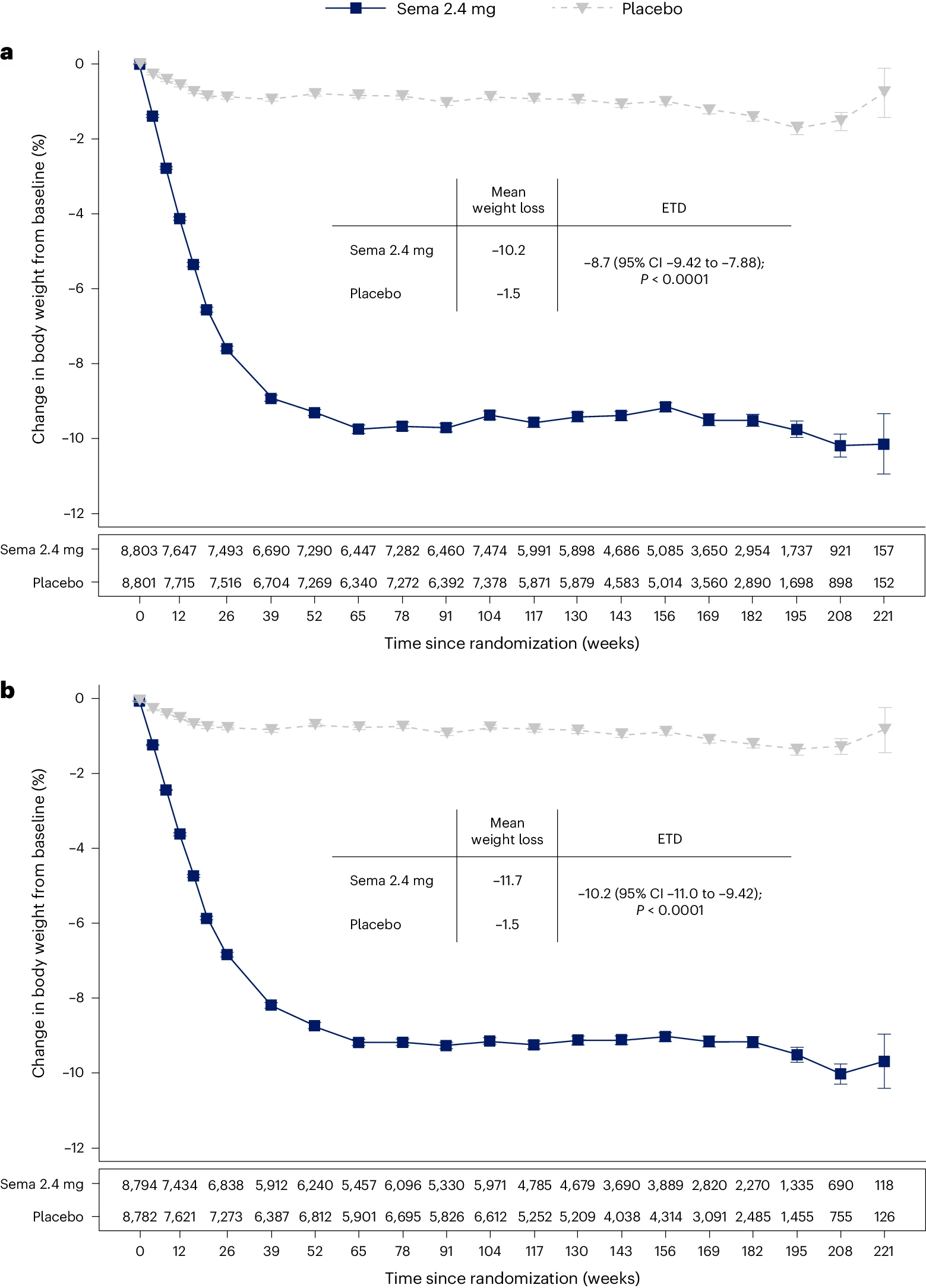](https://bookstack.sassafras.dev/uploads/images/gallery/2026-09/image.png) **Source: [https://www.nature.com/articles/s41591-024-02996-7](https://www.nature.com/articles/s41591-024-02996-7)** While this was visible when you closely looked at some of the published figures, the authors did not address this in the text and obscured it under a figure that ignored the huge change in the number of participants. This raises many questions about the final data and the missing data from those who left the study which is the vast majority of participants. Given Novo Nordisk's assertion that people have to stay on this medication for the rest of their lives in order to maintain weight loss, it is very important that only about 10% of participants managed to stay on the drug for even four years. While there is significant evidence showing that people regain weight after ceasing the drug, there is no research showing that even if people are able to stay on the drug across their life span that they would maintain the weightloss–that is a (profitable) gamble that Novo Nordisk is making with higher weight people’s lives. Even if some number of people do lose weight, at least temporarily, the long-term side effects of taking the drugs at the weight loss dose can be serious, even fatal, and are not well studied. Further, the use of these drugs for weight loss has led to shortages that have impacted the access to the drug for many people with Type 2 Diabetes, many of whom are either contraindicated for other drugs or could not achieve glycemic management with other drugs. The analyses shared in this section on weight and health are the critical pieces needed for us to understand why this study was conducted in the first place. We should be asking questions like the following: - Why did the media report on the study as they did, and why it was eventually published in top journals? - Why do you think journalists would uncritically cover this news? - What cultural values do you think impacted the existence of this study in the first place and its ability to make news? - Who benefits from this kind of study? - Who might be harmed by this study and how? - Who funded the study and to what level were they involved in the design and analysis? - How many of the study authors had conflicts of interest? For more detail on this see our critical science literacy lesson and/or read the following analyses by Ragen Chastain from[ before](https://weightandhealthcare.substack.com/p/novo-nordisks-ethnically-questionable?utm_source=publication-search) the study was published as well as deeper dives once the study[ was published](https://weightandhealthcare.substack.com/p/the-semaglutide-wegovy-cardiovascular) and when[ more data](https://weightandhealthcare.substack.com/p/four-year-outcomes-of-wegovy-semaglutide) from the study was published the following year. # 7. Challenges to the Weight Centric Health Paradigm #### **1. Fat Activism** Let’s begin with a word about language. The terms “ob\*se” and “overw\*ight” were created and put into common usage predominantly by the weight loss industry, for the express purposes of pathologizing bodies based on shared size, rather than shared health metrics. They are considered by weight neutral advocates and fat activists to be harmful and stigmatizing. Terms like higher-weight, larger bodied, and person of size (terms that do not pathologize or medicalize fat bodies and that were not used as slurs) are often used as non-stigmatizing terms. “Fat” is a reclaiming term, with all of the complexities that come with reclaiming terms. While there are some people who might be described as fat who absolutely do not align with the label of “fat” (and that is a valid choice,) many fat people have chosen to reclaim the term as a way to reclaim its power. While nobody is obligated to choose to label themselves fat, it is critical that if people are using the term as a neutral/positive descriptor, that we not correct them or suggest that “fat” is a bad word since, even if someone doesn’t align with the term, claiming that there is something wrong with “fat” necessarily adds to weight stigma. In this module, when we use the term fat, we are always using its reclaimed form as a neutral/positive descriptor (like one might describe themselves as tall or brunette.) Fat activism, as in collective action talking about fat liberation and fighting against discrimination of fat people, in the United States has been documented from at least the 1960’s. We should note that this history coincides and intersects with US based liberation movements, rights movements, and international anti-colonial movements of the 1960’s and 70’s. The most cited activist moments from this time include a 1967 fat-in in Central Park in New York City, the beginning of the National Association to Aid Fat Americans (NAAFA) in 1969 which later became the National Association to Advance Fat Acceptance in the 1980’s, and the more radical Fat Underground collective which was explicitly rooted in feminism and gay liberation. These organizations were founded and steered by white people leading to what has been challenged as an inaccurate picture of the role that Black women played in fat activism during this time. One of the documented counter points to this white-washed history is the oft-cited[ article by welfare activist Johnnie Tillman](https://msmagazine.com/2021/03/25/welfare-is-a-womens-issue-ms-magazine-spring-1972/) in Ms. Magazine where she includes the dehumanization of fat, poor, women as part of her argument for why “welfare is a feminist issue”. The range of fat activism in the US today is large. At one end of the spectrum is the modern “body positivity” movement. Body Positivity was originally created specifically for radical fat liberation, but over time and through influencer culture it has, in many ways, been co-opted by relatively thin, predominantly white women, many of whom still hold and espouse anti-fat views and who may or may not consider more systemic and interconnected reasons for fatphobia. On the other end of the spectrum are more radical, anti-capitalist, anti-racist, anti-imperial organizations such as Fat Rose. ##### **Intuitive eating** In the 1990’s, two nutritionists Evelyn Tribole and Elyse Resch introduced an anti-diet model called intuitive eating based on years of experience in working with people diagnosed with eating disorders. Their model takes diet culture as the problem and aims to instead work with people to build a relationship with food where they can learn to trust their body. It is important to state clearly that in their work, they are clear that there must not be food rules and that it is explicitly anti-diet in its foundational principles. We emphasize this because in recent years as this approach to eating and treating eating disorders has become more and more prevalent and accessible, some have tried to re-assimilate it into the same old weight-centric health paradigm and promoted it as a diet technique. It is a therapeutic intervention that has to do with taking care of root causes of not being able to be in touch with one’s own body because of trauma - individual, medical, and collective and other societally produced thinking about food and bodies that have people removed from their own relationships with their bodies. Although intuitive eating along with other pushbacks from fat activism have increased general awareness of the dangers of diet culture, fad diets and the promotion of calorie (or carb) counting continue. The truth is that[ a 100 year history](https://weightandhealthcare.substack.com/p/who-says-dieting-fails-the-majority) of weight loss interventions has shown that the vast majority of people will lose weight short-term and regain it long-term. Still, restrictive diets - whether they seek to restrict calories, certain foods/food groups, times of eating, or all of the above continue to proliferate. In truth, the health of higher-weight people can be supported nutritionally in the same ways that the health of thin people is supported nutritionally - through access to the information and the food that people want to eat and without restrictive diets that focus on body size manipulation. #### **2. Health Advocacy/Activism** ##### **A. Overview** For as long as the weight-centric paradigm has existed, health advocates and activists both inside and outside the healthcare system have been challenging it. The National Association to Advance Fat Acceptance (NAAFA), the oldest fat liberation organization on record maintains a [list of organizations](https://naafa.org/other-resources-1/#fatorgs).They have pointed out that since the beginning, intentional weight loss research has shown that the vast majority of people will lose weight short term and regain it long term, likely due to the physiological changes that intentional weight loss attempts create. Further, the resulting weight cycling (aka yo-yo dieting) is independently linked to health issues including increased inflammation, cardiovascular disease, and overall mortality. Health activists have pointed out that experiencing weight stigma is also linked to physical and psychological health issues including Type 2 Diabetes and hypertension. Finally, they have highlighted the fact that research (often funded by the weight loss industry) that seeks to blame being higher-weight for health issues fails to mention, let alone control for, these confounding variables and conditions that get called “weight-related” or “ob\*sity-related” may actually be weight-stigma-related health conditions and/or weight-cycling-related health conditions. On the other hand, these advocates and activists continue to create and point to the body of research that shows that weight-neutral health - focusing on supporting health directly rather than on weight loss as a path to health - can provide the same or more health benefits with far fewer risks than weight loss attempts. These health advocates have, and continue to, challenge the weight-centric paradigm and promote the weight-neutral paradigm through multiple channels including educating healthcare providers directly, educating higher-weight people directly, creating newsletters and websites to provide information, becoming medical advocates who support higher-weight people navigating weight stigma in the healthcare system, and forming organizations like the [Association for Size Diversity and Health](https://asdah.org/), [Medical Students for Size Inclusivity](https://sizeinclusivemedicine.org/), and the [Association for Weight and Size Inclusive Medicine](https://weightinclusivemedicine.org/), for support and advocacy. ##### **B. Advocating as a Higher-Weight Person** When one experiences weight stigma in the healthcare system, it is important to begin by reminding ourselves that even though this is becoming our problem, it is absolutely not our fault and it should not be happening. Below are some specific examples. 1. **Declining weigh-in:** Many higher-weight people choose to decline weigh-ins that are not medically necessary. This can be done for many reasons including avoiding something that can be an eating disorder trigger, and avoiding practitioner weight distraction. There are many options for this from just saying “no thank you” to saying “I’m exercising my right to informed refusal of a non-medically necessary weigh-in.” If there is a legitimate medical reason and you choose to move forward with a weight measurement, you can still request to turn around and not view the weight or be told the weight (remember to ask for it to not be added to your chart in this digital age). 2. **Declining weight-loss recommendations:** Patients have a right to healthcare that is based on their own values. For patients who are seeking weight-neutral care, that means declining weight-loss recommendations. This, again, can be accomplished in many ways. One short-cut is to ask the healthcare provider “what would you offer a thin person with this same health issue?” Another is to again say that “I’m exercising my right to informed refusal of weight loss interventions, please move on.” 3. **Asking for accommodation:** Because the healthcare system was built for thin bodies, higher-weight people can find themselves unaccommodated. That can be anything from a lack of sturdy armless chairs, and properly sized blood pressure cuffs, gowns and more to an MRI that fails to accommodate. Here it is critical to remember that you as the patient are NOT too big, the healthcare being offered to you is too small. Healthcare should fit the people who need it, people shouldn’t be asked to change themselves to fit into healthcare. You have the right to ask for accommodations and if the healthcare environment cannot accommodate you, that is not your fault. You may be able to escalate the request or find an alternative facility. ##### **C. Advocating for Higher-Weight People** If you are someone who doesn’t live in a larger body, you can still help advocate for higher-weight people to have equity in their healthcare experiences. Below are some options 1. **Decline weigh-in:** You can help to normalize taking the focus off weight by declining weigh-ins that are not medically necessary. You may begin by saying something like, “no thank you” or ask “why do you need my weight?” depending on your comfort level. It is likely that you will be told that you can just turn around and not look at the number. One possible response to this is “Weight is a poor measure of health” or “Oh, I don’t do weight measurements because it is meaningless for health.” You may end up having a good conversation with a nurse or other healthcare worker who is simply tasked with taking weight and also knows it’s not a good measure of health but is told they have to do this as part of their job. If you want to go further advocating around this practice, you can talk to the doctors who own the practice about removing it as a default. If possible, you could join with other patients to push for this as a change. It has been removed from some doctors offices because of advocacy from patients and therapists and could be a small yet powerful act of local activism (see below for further steps you can take once you are having these conversations). This can help higher-weight people as well as people of all sizes who struggle with disordered eating and eating disorders, or who would prefer not to be weighed publicly. . 2. **Ask for inclusion:** Look around the healthcare provider’s office and notice if there is a lack of inclusion. If you look around the waiting room or the treatment room and you don’t see any armless chairs or loveseats, ask who to talk to about that. Discuss the need for chairs that work for people of all sizes. 3. **Accompany a higher-weight friend/family member:** While it’s very wrong, higher-weight people are often treated better when they are accompanied by someone else. You don’t have to have any specialized knowledge (or even talk,) just being there can be supportive of your loved one. You can chat with them beforehand to see what would make them feel the most supported. Do they want you to speak to them? To the provider? Do they want to arrange a signal (like tugging on their ear) to let you know that they want you to step in? Again, just being there can be incredibly helpful. ##### **D. Advocating within the Healthcare System** If you work in the healthcare system, you can do a lot to create change. Start with the areas where you, personally, have privilege, power, and leverage to make change. Then form coalitions to create more privilege, power, and leverage. 1. **Advocate for inclusion:** Make observations about your space - what are the things that thin people can access that higher-weight people can’t? Are there sturdy, armless chairs everywhere that a patient might sit down? Are there gowns in the largest possible sizes? Are there properly-sized blood pressure cuffs (thigh or [troncoconical](https://weightandhealthcare.substack.com/p/the-need-for-troncoconical-blood)) at every station where vitals are taken? If your facility provides imaging, know the weight capacity and bore size (if applicable) of the equipment. Make this information public both on your website and to all patients when they book in. If you can’t accommodate a patient for any reason, apologize on behalf of the facility (even if it’s not your fault,) assure them that the equipment is the problem, not their bodies, know where to refer them to reduce the chance that they will disengage from care. 2. **Advocate for Education:** Ask for weight bias training 9 (and make sure it’s not coming from the weight loss industry or the “patient advocacy groups” they fund such as the Ob\*sity Action Coalition). Ask for education about the weight-neutral paradigm. That can include everything from conferences, to CMEs to office lunch-and-learns. Bring in experts to help you create the most size-inclusive space possible. 3. **Fight weight stigma:** Work to create an environment where fat-shaming, negative body talk, and diet culture including negative talk about certain foods are seen as unacceptable. They can create a hostile work environment for higher-weight healthcare workers and they create a dangerous environment for higher-weight patients. Interrupt this kind of talk. You can say something general like “I wish we could affirm bodies of all sizes,” or something specific like “that’s weight stigma, we don’t do that here.” Don’t let weight stigma go by unchallenged. If patients talk negatively about their own bodies, you can say something like “I hate how the world teaches people to hate their bodies, instead of helping everyone see that their bodies are valid, amazing, and worthy of love and care.”9. Ragen Chastain, one of the authors, offers this type of training [https://www.sizedforsuccess.com/healthcare.html](https://www.sizedforsuccess.com/healthcare.html) So do Medical Students for Size inclusivity [https://sizeinclusivemedicine.org/](https://sizeinclusivemedicine.org/)