1 - A: Connective Tissue in Non-human Species
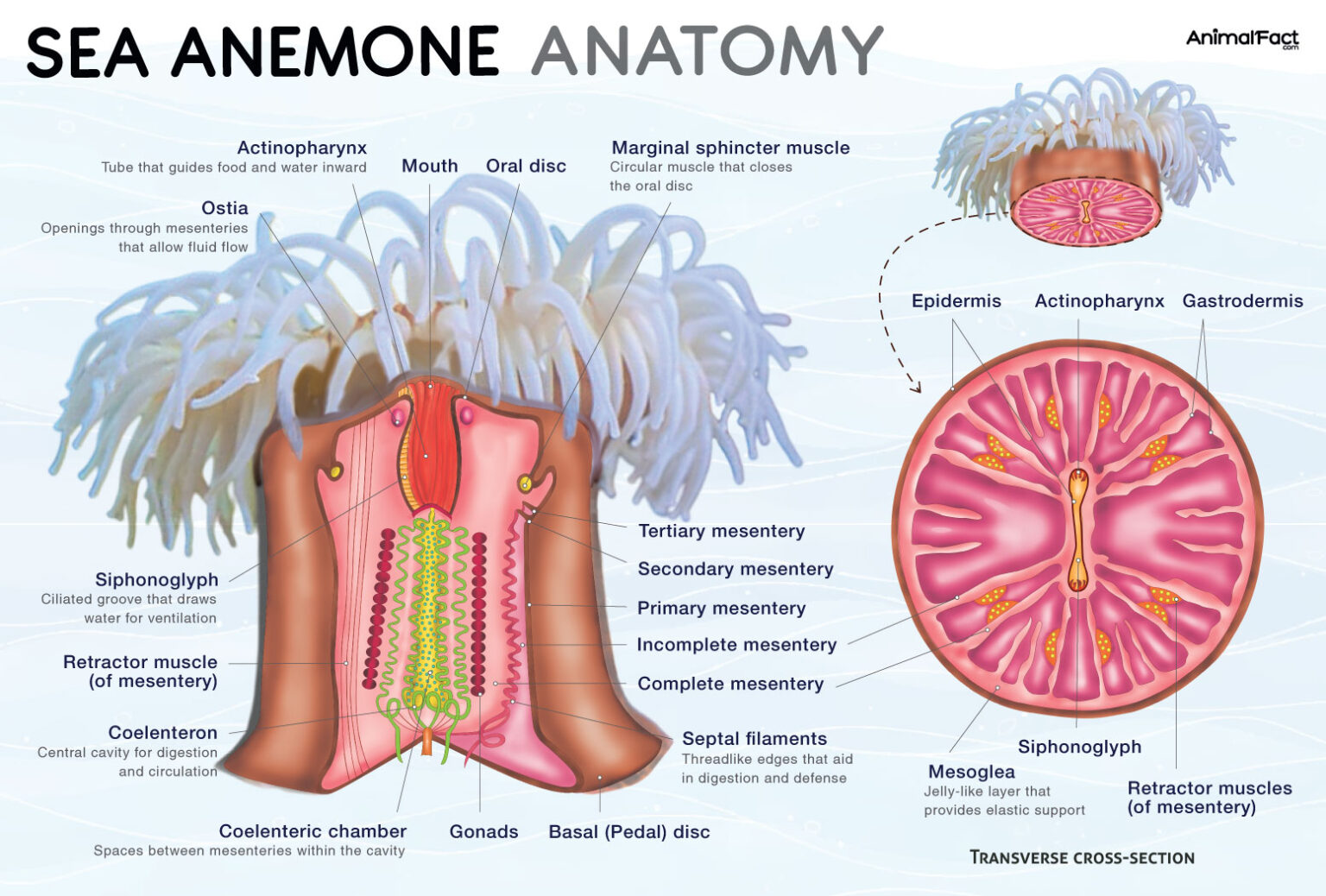
Connective tissue lives up to its name: it connects. The clearest examples of this function can be found in invertebrates, although here it is not technically considered a “tissue.” Sea anemones (see Figure 1) have only two tissue types – the outer epidermis and the gastrodermis. The outer layer is primarily protective and also helps with hunting. The gastrodermis is specialized for digestion. But these layers must be *connected* - the functions must be physically coordinated. The mesoglea serves to connect and coordinate functions and thus composes the hydrostatic “skeleton” of the sea anemone. This invertebrate “skeleton” helps the body maintain form and substance literally connecting hunting with eating.
Figure 1 Sea Anemone Anatomy
Source: https://animalfact.com/wp-content/uploads/2025/09/Sea-Anemone-Anatomy-1536x1038.jpg
The evolution of connective tissue is a key moment in producing multicellular bodies in animals. Our cell’s ability to stick together means we can have specialized cells and tissues. Some cells can focus on one task and share their work with other cells that have a different function. In sea anemones, this can be reduced to hunting and eating. But in humans and other more complex organisms, there are hundreds of different cell types, each with their own function and all connected to form a whole creature.
No comments to display
No comments to display