4.1 Anisogamy and Its Limitations
Biological sex is only assigned to individuals that reproduce through the formation and merging of different size gametes, not those that are isogametic as discussed above. The convention is that organisms that make small, abundant and often motile gametes are called males, while organisms that make larger, fewer and often immotile gametes are called females, although there are many exceptions to this general rule. Individuals that do not produce gametes, and those that produce both are left out of this categorization of sex. Therefore, while the description of species as gonochoristic (male or female) describes many sexually reproducing organisms, it does not encompass all known variation even within species. For example organisms that do not produce gametes or have differentiated gonads for most of their life are left out of this classification. Some examples include corals, caterpillars, and organisms that change sex between males and females, and are often in transition (as in many sequential hermaphrodites). Organisms that make both types of gametes either sequentially or simultaneously are called hermaphrodites (a term that is not acceptable for humans anymore, but it is extensively used in plants and other animals) or co-sexuals, and this category is often also left out of discussion of gametic sex. Nevertheless this use of the morphology and function of sperm and eggs as central to classifying males and females in biology is an enduring categorization because biologists decided on the use of these terms and what they include. However, inclusion of additional “neither” and “both” categories to gamete type are clearly necessary to encompass all existing variation of gamete status in sexually reproducing species.
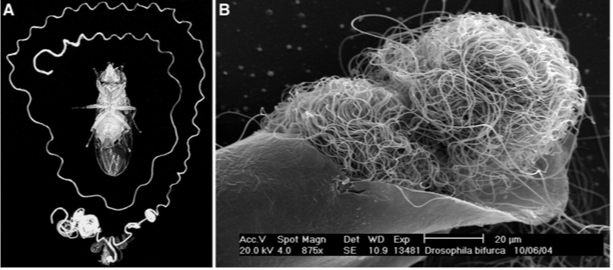
In addition to the necessity of using male/female/neither/both as categories to describe the gamete status of sexually reproducing organisms, it is also important to note that the classification of sperm as small, numerous and motile, and eggs as large, immotile and few in number, is also not as clear cut as it seems. Some insect species exclusively produce sperm that are non-motile, for example in Psychodidae flies. In addition, sperm are not always small and numerous. For example, in Drosophila bifurca, a species of fruit fly, males produce only a handful of sperm (often 5) that are extremely large, measuring up to 5 mm in length, therefore violating the “rule” that males produce a lot of tiny gametes since males only produce 100 or so sperm in their lifetime. In this case, we call them sperm because they are clearly not eggs, not because they have all the characteristics that sperm are supposed to have. Some Lepidoptera species have two sperm types: Eupyrene and apyrene, where only eupyrene sperm are capable of fertilization, while apyrene sperm lack a nucleus and chromosomes. Again, they are classified as sperm contra eggs, not because of their intrinsic properties. They are sperm because they are made by the male, using circular reasoning to maintain the categorization that we created. We could have decided that Lepidopteran individuals that make two different types of gametes in their gonads should be called something other than a male, but we did not.
Phenotypic plasticity: Characteristics such as size and number of gametes produced are not fixed, but are known to respond to the social environment. For example, in broadcast spawners, raising ascidians in high density environments results in sperm that are larger and more motile than those found in low density environments (Crean & Marshall, 2008). The eggs also change to become larger overall at low densities, and smaller at high densities, particularly in the portion of the egg where fertilization takes place, essentially making a larger target when sperm are fewer.
Fig 3. The giant sperm of Drosophila bifurca can be 6 mm long. From Pitnick
No comments to display
No comments to display