5.2 - Sustainable Development Goals (SDGs) & Planetary Boundaries
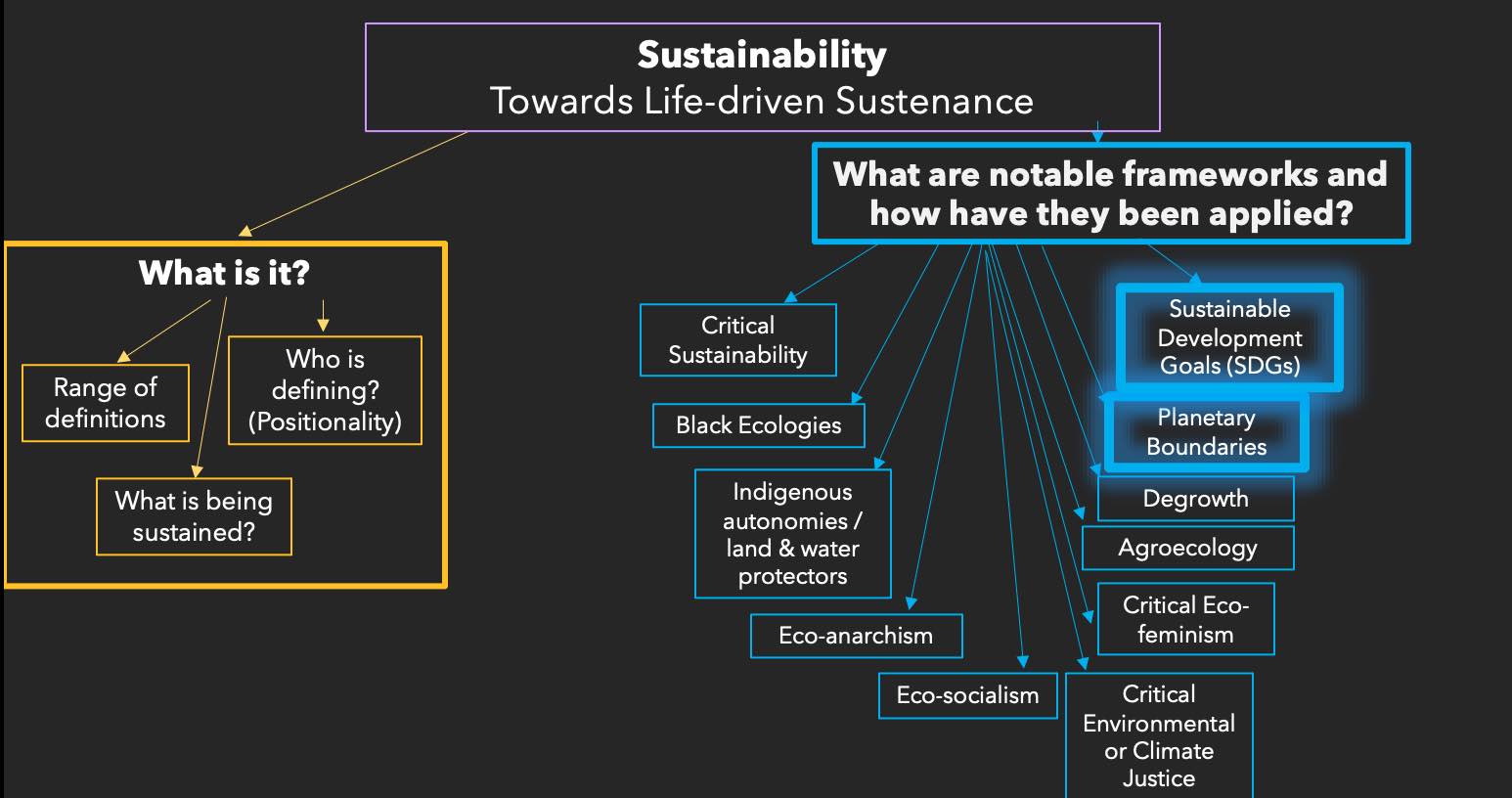
Two of the most prominent mainstream sustainability frameworks include the United Nations anthropocentric focused sustainable development goals (SDGs) and the techno-scientific, ecocentric planetary boundaries. Interestingly, these reflect a long-standing cartesian dualism between anthropocentric and ecocentric approaches to sustainability.
The sustainable development goals (SDGs) are the most recent multilateral set of global goals (its predecessor being the Millenium Development Goals) that include a total of 17 goals and 169 targets created by the United Nations that define the guidelines for policies on sustainable development from 2015 to 2030 (Kothari et al 2019). In their book ‘Pluriverse: a post-development dictionary’, Kothari et. al. (2019) summarize the key critiques of sustainable development highlighting the structural imposition of a neoliberal globalization agenda that makes ‘economic growth’ a necessary step in sustainable development by arguing that “a high standard of living is necessary before using resources to protect the environment”. A high standard of living as defined by the neoliberal and neoimperialist agendas of the Global North refers to a homogenizing model of modernity where individuals have ‘jobs’, access to healthcare, schooling, the right to ‘vote’ for political parties, and the ability to be consumers plugged into a global market.
The framework of planetary boundaries refers to specific thresholds for 9 key earth system processes, or planetary boundaries, within which humanity can continue to survive, develop and thrive by maintaining the current Holocene epoch-like planetary conditions (‘safe operating space’) for generations to come as identified by a group of earth system scientists. These include climate change, biosphere integrity, biogeochemical flows, land system change, freshwater change, ocean acidification, chemical pollution and novel entities (plastics), stratospheric ozone depletion, and atmospheric aerosol loading (Rockstrom, 2009; van Vuuren etal 2025). This framework has been highly influential in igniting environmental academic debate and in shaping research programs and environmental policy at national and international scales.
To really dive into the planetary boundaries sutainability framework watch the Netflix documentary – Breaking Boundaries: the science of our planet (73 mins). Remember to use our key guiding questions to interrogate.
Without a doubt, there are parallel dialogues and liberatory movements for a more dignified and sustainable existence on Earth that emanate from traditions of resistance, Marxism, anarchism and land and water protectors that includes Black ecologies, Indigenous ecologies, degrowth, ecofeminism, ecoanarchism, agroecology, ecosocialism, climate justice and critical sustainabilities (to name a few). It is these frameworks that I invite you to delve into as we think about a more just, liberatory, and dignified sustainability.
For the remainder of this module, I will introduce ‘Black ecologies’ as a sustainability framework to exemplify how the ‘key guiding questions’ can be used on our learning journey.
anthropocentric = an ideology or approach to sustainability that prioritizes human socioeconomic development (in line with capitalist modernity) including ending world hunger, the eradication of poverty, the reduction of inequality, economic growth, and decent jobs (Biermann and Kim 2020).
ecocentric = an ideology or approach to sustainability that prioritizes the protection of nature and the environment over socioeconomic development.
neoliberal globalization
economic growth
Global North =
No comments to display
No comments to display