6.3 - NEED A TITLE FOR THIS PAGE - Cancer Alley, Maybe?
To ground this first aim of Black Ecologies, let’s analyze the powerful case study of Louisiana’s “Cancer Alley” which is located within an industrial stretch of the Mississippi River between the U.S. cities of Baton Rouge and New Orleans. Cancer Alley is a region with predominantly Black and working class communities and it is one of the most highly polluted areas in the US with some counties (also locally called ‘parishes’) with as many as ~13,000 cases of cancer. Despite this public health crisis, Louisiana continues to approve new plants and the expansion of existing ones.
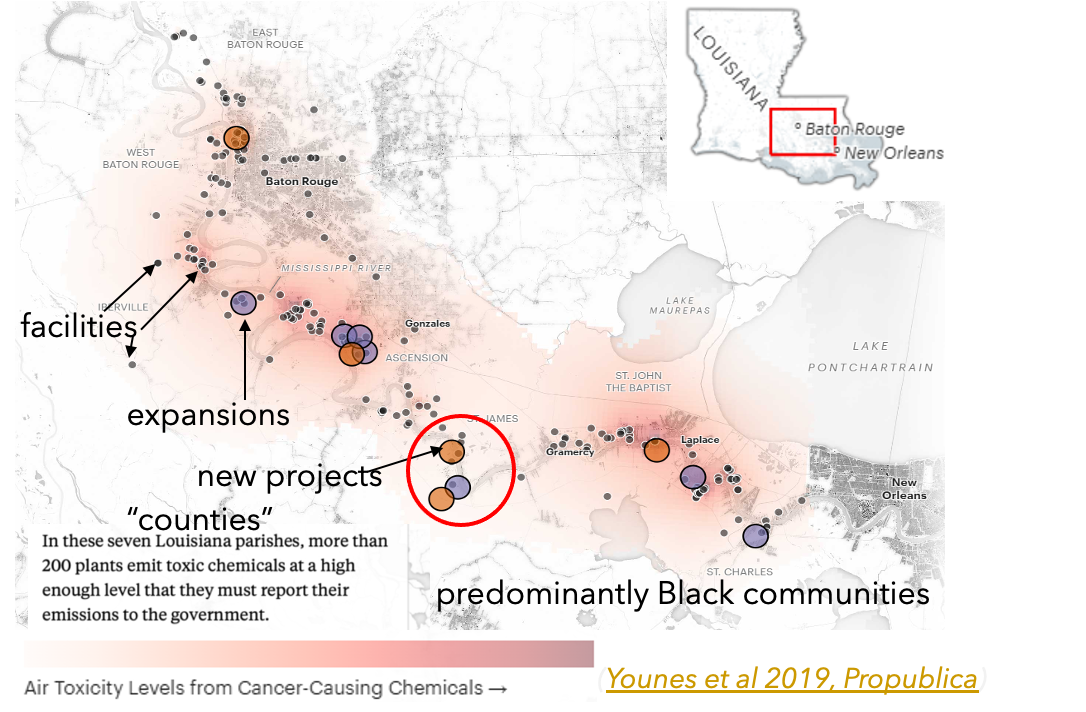
(Source: Younes et al 2019, Propublica)
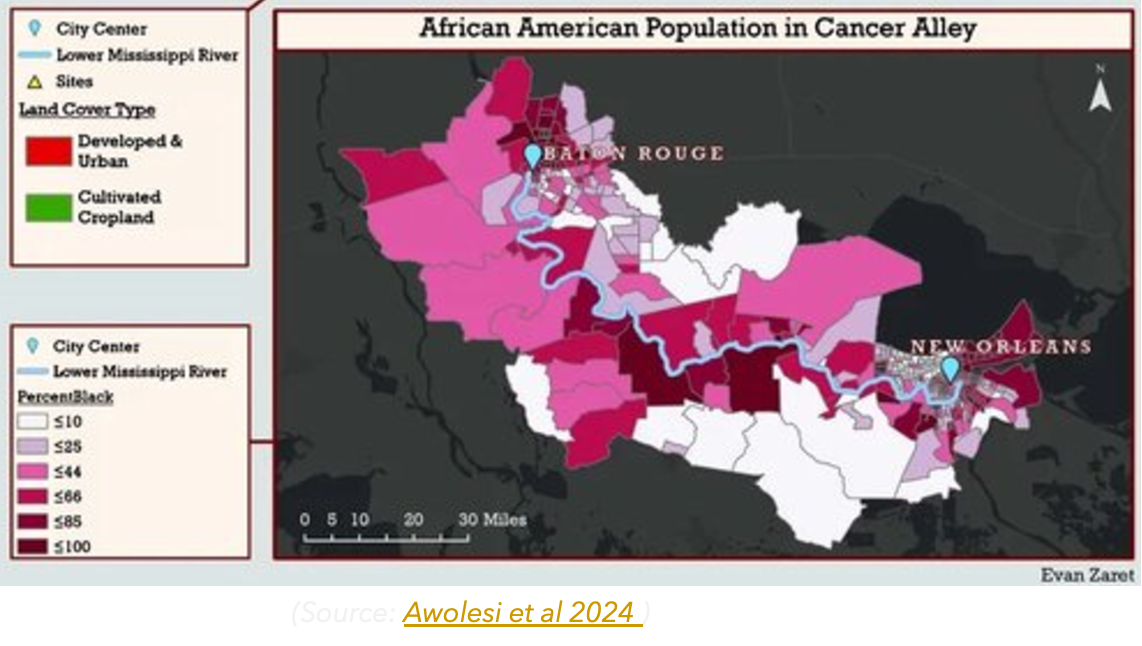
(Source: Awolesi et al 2024)
Studies show that Black people are 75% more likely to live near oil and gas refineries, and Black Americans face higher risks of premature death from power plant pollution (Fleischman and Franklin 2017) .
Consider the following questions:
1. At the end of the article, you are prompted to “Look up an address, ZIP code or landmark within East Baton Rouge, West Baton Rouge, Iberville, Ascension, St. James, St. Charles or St. John parishes to find how toxic the air is.” Go ahead and use this tool for a couple of locations and report on what you found.
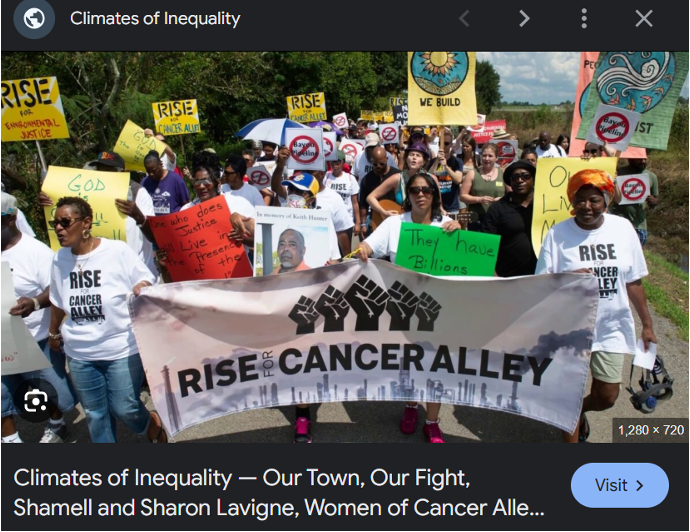
2. Take a moment to search for organizing and actions that the affected communities have done to defend and protect themselves and their families? What has been the result?
3. Compare the two map images above. On the left, the map shows the location of existing and planned expansions or new power plant facilities. On the right, we see the percent of the population within each parish that is Black. What are some of the spatial patterns that you notice where overlaps do (or don’t) occur?
4. This propublica report was published in October 2019. See if you can find if any of the proposed new plants or plant expansions did indeed go into effect and what is the most recent news regarding this case.
5. How does this case study exemplify Black Ecologies?
6. Read the methodology for the analysis done at the link below.
https://www.propublica.org/article/how-we-found-new-chemical-plants-are-being-built-in-south-louisianas-most-polluted-areas
a) Write a summary of what you understand are the key parts of the methodology.
b) What is the difference between data obtained through a model and data obtained empirically?
c) Why is this study a powerful example of using an EPA model to promote change and justice?
d) What are the questions that arise for you?
Additional reading:
https://www.axios.com/local/chicago/2022/02/17/chicago-redlining-then-and-now
Fleischman and Franklin. 2017. Fumes Across the Fence Line: the health impacts of air pollution from oil and gas facilities on African American communities. NAACP & CATF Report: https://naacp.org/resources/fumes-across-fence-line-health-impacts-air-pollution-oil-gas-facilities-african-american
No comments to display
No comments to display